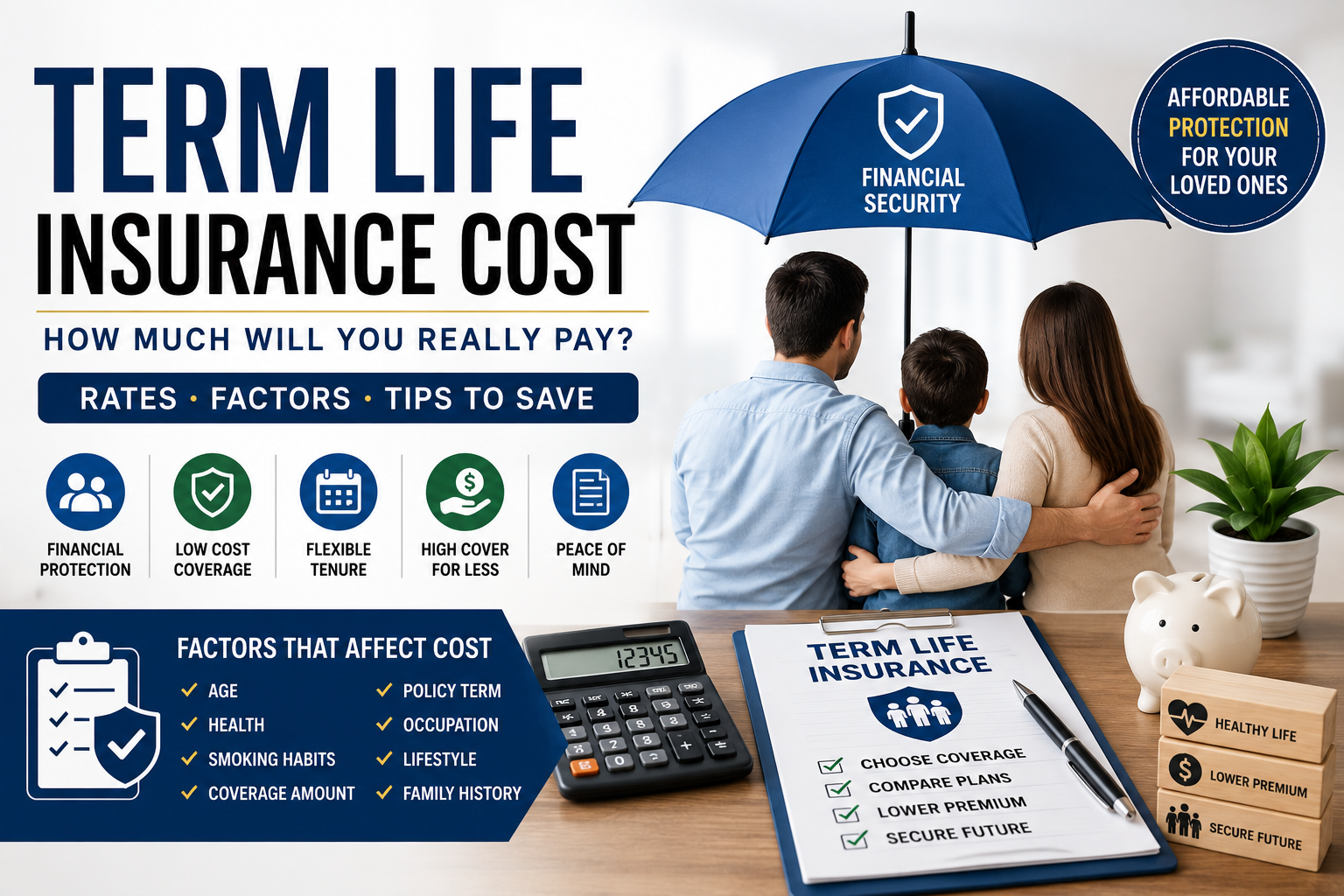
Learn what affects term life insurance cost, average rates, pricing factors, coverage options, and practical ways to lower your premium.
term life insurance cost
When people start shopping for life insurance, one of the first questions they ask is simple: How much does term life insurance cost?
The answer is more complicated than a single monthly price.
Term life insurance is generally designed to provide financial protection for a specific period, such as 10, 20, or 30 years. During that period, you pay a premium, and if you die while the policy is active, the insurer generally pays the stated death benefit to your beneficiaries, subject to the policy’s terms and exclusions.
The cost of that protection can vary substantially from one person to another.
Age, health, smoking status, coverage amount, policy length, occupation, family medical history, and the type of underwriting can all affect what an insurer charges. Two people of the same age can receive very different premiums because their risk profiles are different.
Understanding term life insurance cost before requesting quotes can help you choose an appropriate coverage amount, compare policies more intelligently, and avoid paying for more coverage than you actually need.
This guide explains how term life insurance pricing works, what influences premiums, how different policy terms compare, how underwriting affects price, and practical ways to keep your costs under control.
Important: Life insurance pricing varies by insurer, location, underwriting rules, and individual circumstances. The figures discussed in this article are general illustrations, not personalized insurance quotes.
What Is Term Life Insurance?
Term life insurance is a type of life insurance that provides coverage for a defined period.
Common policy terms include:
- 10 years
- 15 years
- 20 years
- 25 years
- 30 years
If the insured person dies during the covered term, the policy can provide a death benefit to the named beneficiaries, assuming the policy is in force and the claim meets its terms.
If the policyholder survives the term, coverage generally ends unless the policy is renewed, converted, or otherwise extended according to its contract.
Simple example
Imagine a 30-year-old purchases a 20-year term life insurance policy with a $500,000 death benefit.
If the policy remains active and the insured dies during those 20 years, the beneficiaries could receive the $500,000 death benefit, subject to the policy’s conditions.
If the insured reaches the end of the 20-year period alive, the original term coverage normally expires unless another provision applies.
This temporary structure is one reason term life insurance can be relatively affordable compared with many forms of permanent life insurance.
How Much Does Term Life Insurance Cost?
There is no universal price for term life insurance.
A healthy young adult purchasing a modest policy may receive a relatively low premium, while an older applicant seeking a large death benefit for a long term may pay considerably more.
For many healthy applicants, term coverage can cost somewhere from tens of dollars per month to well over $100 per month, depending on the circumstances.
However, averages can be misleading.
A policy’s cost can change significantly based on:
| Pricing Factor | Potential Effect |
|---|---|
| Age | Older applicants generally pay more |
| Health | Healthier applicants often pay less |
| Smoking | Usually increases premiums substantially |
| Coverage amount | More coverage generally costs more |
| Policy term | Longer terms generally cost more |
| Occupation | Higher-risk work can affect pricing |
| Lifestyle | Certain high-risk activities may increase premiums |
| Underwriting | More detailed underwriting can produce individualized pricing |
| Policy type | Simplified or no-exam options may cost more |
The best way to understand your actual price is to compare quotes based on your personal circumstances.
Average Term Life Insurance Cost by Age
Age is one of the most important factors in life insurance pricing.
In general, younger applicants have a lower mortality risk over the upcoming policy period. As age increases, the probability of death during a given term generally increases, which can result in higher premiums.
An illustrative pattern might look like this:
| Age | Example Coverage | Typical Pricing Trend |
|---|---|---|
| 25 | $500,000 / 20 years | Lower |
| 30 | $500,000 / 20 years | Lower |
| 35 | $500,000 / 20 years | Moderate |
| 40 | $500,000 / 20 years | Moderate |
| 45 | $500,000 / 20 years | Higher |
| 50 | $500,000 / 20 years | Higher |
| 55 | $500,000 / 20 years | Significantly higher |
| 60 | $500,000 / 20 years | Often substantially higher |
These are pricing patterns rather than guaranteed rates.
A 40-year-old in excellent health may receive a much better offer than another 40-year-old with significant health risks.
Why Age Has Such a Big Impact on Life Insurance Cost
Life insurance is fundamentally a risk-based financial product.
An insurer estimates the likelihood that it will need to pay a death benefit during the policy period.
A younger applicant generally has a lower probability of dying during a 20- or 30-year term than an older applicant.
For example, consider two people applying for identical coverage:
- Applicant A: age 28
- Applicant B: age 58
Even if both applicants want the same $500,000 death benefit, the insurer may view their risk very differently.
The older applicant has fewer years before the statistical probability of death increases, so the premium may be substantially higher.
This is one reason purchasing appropriate coverage earlier can sometimes reduce the long-term cost of protection.
How Health Affects Term Life Insurance Cost
Health can have a major impact on premiums.
During underwriting, an insurer may consider factors such as:
- Blood pressure
- Cholesterol
- Diabetes
- Heart disease
- Cancer history
- Weight
- Prescription medications
- Previous surgeries
- Other medical conditions
- Family medical history
The exact underwriting criteria vary between insurers.
Health classifications
Depending on the insurer, applicants may be placed into different underwriting classes.
Common categories can include:
- Preferred
- Standard
- Substandard
- Preferred non-smoker
- Standard non-smoker
- Smoker
The names differ by company.
The general concept is that applicants with lower assessed mortality risk may receive lower premiums.
How Smoking Affects Term Life Insurance Cost
Smoking is one of the most significant lifestyle factors in life insurance pricing.
Smokers generally face higher premiums because tobacco use is associated with increased risks of serious diseases and premature death.
Insurers may consider:
- Cigarettes
- Cigars
- Tobacco products
- Nicotine use
- Certain vaping products
The exact treatment of nicotine products depends on the insurer’s underwriting rules.
If you smoke, it is important to answer application questions honestly.
Providing inaccurate information can create problems later, particularly during the claims process.
Does Weight Affect Life Insurance Premiums?
It can.
Insurers may consider height and weight when assessing overall health risk.
Weight itself is not necessarily the only factor.
Underwriters may also look at:
- Blood pressure
- Cholesterol
- Diabetes risk
- Medical history
- Lifestyle
- Other health indicators
Someone with a higher weight but otherwise favorable health indicators may receive a different underwriting outcome from someone with the same weight and additional medical complications.
Therefore, it is not useful to assume that a particular weight automatically produces a specific premium.
How Coverage Amount Affects Term Life Insurance Cost
The death benefit is another major pricing factor.
A $250,000 policy generally costs less than a $1 million policy for the same applicant and term.
Consider these hypothetical coverage levels:
- $250,000
- $500,000
- $750,000
- $1 million
- $2 million
As coverage increases, the insurer takes on greater financial exposure.
That usually means a higher premium.
However, the increase is not necessarily perfectly proportional.
For example, a $1 million policy does not necessarily cost exactly twice as much as a $500,000 policy.
Pricing depends on the insurer’s underwriting and rate structure.
How Policy Length Affects Term Life Insurance Cost
The length of the policy matters.
A 10-year policy will generally cost less than a 30-year policy for the same applicant and coverage amount.
Why?
Because the insurer is agreeing to provide protection for a longer period.
Longer terms also extend into ages where mortality risk is higher.
General comparison
| Policy Term | Relative Cost |
|---|---|
| 10 years | Usually lowest |
| 15 years | Low–moderate |
| 20 years | Moderate |
| 25 years | Higher |
| 30 years | Often highest |
The cheapest policy is not necessarily the best policy.
The term should match the period during which your dependents actually need financial protection.
How to Choose the Right Term Length
Think about the financial obligations you want the policy to cover.
For example, you may want coverage until:
- Your children become financially independent
- Your mortgage is substantially reduced or paid off
- Your spouse reaches retirement
- Your business debt is resolved
- Your major financial obligations decrease
Example
Suppose you have:
- Two young children
- A 25-year mortgage
- A spouse who depends partly on your income
A 10-year policy may end before some major financial responsibilities disappear.
A 20- or 30-year policy might provide a longer protection period.
The correct choice depends on your individual financial situation.
Term Life Insurance Cost vs. Permanent Life Insurance
One of the most important comparisons is term life insurance versus permanent life insurance.
| Feature | Term Life | Permanent Life |
|---|---|---|
| Coverage duration | Fixed term | Generally lifelong if maintained |
| Premiums | Often lower | Often higher |
| Cash value | Usually none | Some policies accumulate cash value |
| Main purpose | Temporary financial protection | Lifetime protection and other financial features |
| Complexity | Generally simpler | Usually more complex |
| Suitable for | Income replacement and temporary obligations | Lifetime coverage and specific financial planning needs |
Term insurance is often attractive to people who primarily need affordable income protection.
Permanent insurance may be appropriate for different objectives, but it typically requires a larger financial commitment.
Why Term Life Insurance Can Be Affordable
Term life insurance generally focuses on one primary benefit:
A death benefit during a defined period.
It typically does not include the cash-value component associated with many permanent policies.
This simpler structure can make term coverage more affordable for people who want substantial death-benefit protection without paying for additional policy features.
For example, a young parent might prioritize:
- Mortgage protection
- Income replacement
- Childcare expenses
- Education funding
- Household financial stability
A term policy can address these risks at a comparatively manageable premium.
What Is Included in a Term Life Insurance Premium?
Your premium is the amount you pay to keep your policy active.
Depending on the policy and payment arrangement, premiums may be paid:
- Monthly
- Quarterly
- Semi-annually
- Annually
The insurer determines the premium based on its underwriting and pricing model.
Factors may include:
- Age
- Sex
- Health
- Smoking status
- Coverage
- Term length
- Occupation
- Lifestyle
- Medical history
Some policies offer level premiums, meaning the premium remains consistent throughout the initial term.
Others may have different structures.
Always read the policy documents carefully to understand how premiums work.
Level Term Life Insurance
Level term life insurance generally means the death benefit remains constant throughout the policy term, and the premium is typically designed to remain level during that period.
For example:
$500,000 coverage → 20 years → level premium
This structure makes budgeting easier because you know the expected premium amount during the level-premium period.
Level term coverage is popular because it is relatively straightforward.
Annual Renewable Term Insurance
Annual renewable term insurance generally provides coverage for one year at a time, with the ability to renew according to the policy terms.
The premium can increase as the insured gets older.
This type of structure can be useful in specific situations, but it may become more expensive over a long period than a level-term policy.
For someone who expects to need coverage for many years, comparing total expected costs is important.
No-Exam Term Life Insurance
Some insurers offer life insurance policies that require little or no traditional medical examination.
These policies may use information such as:
- Health questionnaires
- Prescription databases
- Medical records
- Other underwriting data
The major advantage is convenience.
The potential disadvantage is cost.
Because the insurer may have less detailed medical information, pricing can sometimes be higher than fully underwritten coverage for an otherwise healthy applicant.
However, this varies by insurer and product.
Simplified-Issue Life Insurance
Simplified-issue life insurance typically requires less medical underwriting than a fully underwritten policy.
Applicants may answer health questions instead of completing a traditional medical exam.
This can speed up the application process.
It may appeal to people who:
- Want faster decisions
- Prefer convenience
- Dislike medical exams
- Need coverage quickly
However, convenience can come with trade-offs.
Before choosing simplified underwriting, compare the premium, coverage amount, exclusions, and policy terms against fully underwritten alternatives.
Fully Underwritten Term Life Insurance
Fully underwritten coverage generally involves a more detailed assessment of the applicant’s health and risk.
Depending on the policy, this may involve:
- Health questions
- Medical records
- Prescription history
- Laboratory testing
- Medical examination
The process can take longer.
However, healthy applicants may benefit from more individualized pricing.
If you are young and healthy and do not need immediate coverage, comparing fully underwritten options may be worthwhile.
How Occupation Can Affect Life Insurance Cost
Certain occupations may carry higher risks.
Examples can include jobs involving:
- High elevations
- Dangerous machinery
- Explosives
- Aviation
- Offshore work
- Emergency response
- Certain transportation activities
An office professional and a worker in a high-risk occupation may not receive identical pricing.
The insurer evaluates the specific duties rather than simply the job title.
How Hobbies Can Affect Life Insurance Cost
Risky hobbies can also affect underwriting.
Examples may include:
- Skydiving
- Scuba diving
- Mountain climbing
- Private aviation
- Certain motorsports
Not every hobby automatically increases premiums.
Insurers may consider frequency, experience, certifications, and the exact nature of the activity.
Always answer application questions accurately.
Family Medical History and Life Insurance Pricing
Family history can sometimes influence underwriting.
An insurer may ask about significant medical conditions among close relatives, particularly when they occurred at relatively young ages.
Possible considerations include:
- Heart disease
- Cancer
- Stroke
- Hereditary conditions
- Other serious illnesses
Family history does not necessarily mean you will receive a high premium.
Underwriting considers the broader risk profile.
Why Two People Can Pay Different Prices
Imagine two applicants:
Applicant 1
- Age 32
- Non-smoker
- Healthy
- $500,000 coverage
- 20-year term
Applicant 2
- Age 32
- Smoker
- Significant health history
- $500,000 coverage
- 20-year term
They are the same age and want identical coverage.
Yet their premiums could be dramatically different.
This demonstrates why online “average cost” figures should be treated as estimates rather than personal quotes.
How to Lower Your Term Life Insurance Cost
You cannot control every pricing factor.
You can, however, make some decisions that may improve your overall cost.
1. Buy Coverage When You Are Younger
Age is a major pricing factor.
If you know you will need life insurance for future financial responsibilities, purchasing appropriate coverage earlier may result in lower premiums than waiting until later.
However, buying insurance you do not actually need can also be wasteful.
The goal is not simply to buy early.
The goal is to buy appropriate coverage when the need exists.
2. Maintain a Healthy Lifestyle
Health can affect underwriting.
Improving overall health may help in some circumstances, although underwriting decisions vary.
Potentially useful habits include:
- Avoiding tobacco
- Maintaining healthy blood pressure
- Exercising regularly
- Eating a balanced diet
- Managing existing health conditions
- Following medical advice
Do not make major health decisions solely to obtain a lower insurance premium.
3. Avoid Unnecessary Coverage
More coverage generally costs more.
Calculate how much financial protection your family actually needs.
You may not need a $2 million policy if your realistic financial obligations are substantially lower.
How Much Life Insurance Coverage Do You Need?
There is no universal formula.
A useful starting point is to consider:
Income replacement
How much income would your family need if you died?
Debts
Consider:
- Mortgage
- Personal loans
- Credit obligations
- Business debt
Future expenses
These might include:
- Children’s education
- Childcare
- Long-term household expenses
Existing assets
Consider:
- Savings
- Investments
- Retirement accounts
- Existing life insurance
Final expenses
Include funeral and other end-of-life costs.
A Simple Life Insurance Calculation
One basic approach is:
Coverage Need = Debts + Future Expenses + Income Replacement − Existing Assets
This is only a starting framework.
Example
Suppose someone estimates:
- $250,000 mortgage
- $100,000 education needs
- $500,000 income replacement
- $50,000 other obligations
- $200,000 existing assets
The rough calculation would be:
$250,000 + $100,000 + $500,000 + $50,000 − $200,000 = $700,000
That suggests approximately $700,000 of coverage under this simplified model.
A professional financial review can produce a more personalized estimate.
Is a $500,000 Term Life Insurance Policy Enough?
It depends.
For one household, $500,000 may provide substantial protection.
For another, it may be insufficient.
Consider:
- Household income
- Number of dependents
- Mortgage
- Debt
- Children’s ages
- Existing assets
- Spouse’s income
- Future financial goals
Coverage should be based on the financial need rather than an arbitrary round number.
Is a 20-Year Term Life Insurance Policy Enough?
A 20-year policy can be appropriate for someone whose major financial responsibilities are expected to decline over approximately two decades.
For example, a parent with young children might want coverage until the children become independent.
However, someone with a long-term mortgage or permanent financial dependency may need a longer term.
The correct duration is connected to the time period of financial risk.
Term Life Insurance Cost for Families
Families often purchase term insurance primarily for income protection.
If one income disappears unexpectedly, the surviving family may face:
- Mortgage payments
- Rent
- Childcare
- Education costs
- Food and household expenses
- Transportation
- Medical costs
- Debt payments
A properly sized policy can help provide financial stability.
Example
A family with two children may purchase a 20- or 30-year policy because their financial obligations are expected to remain significant for many years.
The goal is not to create wealth.
The goal is to protect the family’s financial plan from an early death.
Term Life Insurance for Young Adults
Young adults often underestimate the value of life insurance because they may have few dependents.
In some cases, they may not need a large policy.
However, life insurance can become relevant when someone has:
- A spouse
- Children
- A mortgage
- Co-signed debts
- Business obligations
- Financial dependents
A young person may also consider coverage if they anticipate needing insurance later and want to evaluate the cost while they are relatively young and healthy.
Still, life insurance should be based on an actual financial need rather than pressure to buy a product unnecessarily.
Term Life Insurance for Parents
Parents often have a clear need for financial protection.
If a parent dies prematurely, the surviving family may need money to replace lost income and cover future expenses.
A term policy can help protect:
- Housing
- Childcare
- Education
- Everyday expenses
- Long-term financial goals
Parents should consider both parents’ economic contributions.
A stay-at-home parent, for example, may provide substantial unpaid childcare and household services that would be expensive to replace.
Term Life Insurance for Business Owners
Business owners may have different insurance needs.
Life insurance can potentially support:
- Business debt protection
- Business continuity
- Buy-sell agreements
- Key-person planning
- Family financial protection
Business insurance arrangements can become complex, so business owners should understand the legal and financial structure before purchasing a policy.
Can Term Life Insurance Be Converted?
Some term policies include a conversion feature that allows the policyholder to convert some or all of the term coverage into a permanent life insurance policy, subject to the policy’s rules.
This can be valuable because it may allow the policyholder to obtain permanent coverage without going through the same level of medical underwriting again.
However, conversion provisions vary.
Check:
- Conversion deadline
- Eligible policy types
- Available permanent policies
- Premium changes
- Coverage limitations
Do not assume every term policy has identical conversion rights.
What Happens When a Term Life Insurance Policy Ends?
When the policy term ends, several possibilities may apply depending on the contract.
The policy may:
- Expire
- Be renewable
- Convert to permanent coverage
- Continue under different premium terms
If you are approaching the end of a policy, review your options before the expiration date.
Waiting until the last minute can limit your choices.
Should You Renew Term Life Insurance?
Renewal may be useful when you still need financial protection.
However, premiums can increase substantially as you get older.
Consider:
- Current health
- Age
- Financial responsibilities
- New insurance quotes
- Remaining debts
- Dependents
- Existing assets
If your financial situation has changed significantly, you may no longer need the same amount of coverage.
How to Compare Term Life Insurance Quotes
Do not compare policies based only on monthly premium.
Review:
Death benefit
How much does the policy pay?
Term length
How long does coverage last?
Premium structure
Is the premium level or does it change?
Underwriting
Does the policy require a medical exam?
Conversion
Can the policy be converted?
Renewal
What happens when the term ends?
Exclusions
What circumstances may affect eligibility for benefits?
Financial strength and reliability
Consider the insurer’s ability to meet long-term obligations.
A cheaper policy is not necessarily the better policy if it has less suitable terms.
Common Mistakes When Buying Term Life Insurance
Buying Too Little Coverage
A low premium is meaningless if the death benefit cannot adequately protect your family.
Buying Too Much Coverage
Over-insuring can create unnecessary expenses.
Choosing the Wrong Term
A policy that expires while your dependents still rely on you may create a coverage gap.
Focusing Only on Price
Two policies with identical premiums can have different features and conditions.
Hiding Health Information
Always provide accurate information.
Misrepresentation can create serious problems during underwriting or claims.
Waiting Too Long
If you know you need coverage, delaying can mean applying at an older age or after health changes.
How Inflation Affects Life Insurance Coverage
A policy purchased today may have a different real-world purchasing power decades from now.
For example, $500,000 today will not necessarily provide the same purchasing power 20 or 30 years from now.
When choosing coverage, consider:
- Expected inflation
- Income growth
- Future education costs
- Mortgage balance
- Household expenses
This is another reason to review your financial protection periodically.
Term Life Insurance Cost: Monthly vs. Annual Payments
Some insurers offer different payment frequencies.
You may pay:
- Monthly
- Quarterly
- Semi-annually
- Annually
The total annual cost can vary depending on the payment arrangement.
If an annual payment produces a lower overall cost than paying monthly, it may be worth considering if the larger upfront payment fits your budget.
Always compare the actual total premium rather than assuming one payment schedule is automatically cheaper.
Does Credit Score Affect Term Life Insurance Cost?
Life insurance underwriting generally focuses primarily on insurance-related risk rather than treating a credit score like a standard lending decision.
However, insurers can have different underwriting practices, and financial information may be handled differently depending on jurisdiction and product.
Do not assume that having a particular credit score automatically determines your life insurance premium.
Can You Get Term Life Insurance With Health Problems?
Having a health condition does not automatically mean you cannot get term life insurance.
The outcome depends on factors such as:
- Condition
- Severity
- Treatment
- Stability
- Age
- Medical history
- Overall health
- Insurer underwriting guidelines
Some applicants may receive standard coverage, others may pay a higher premium, and some may face limitations or exclusions.
The most practical approach is to compare insurers rather than assuming one underwriting decision applies everywhere.
Can You Get Term Life Insurance After Age 50?
Yes, many insurers offer term life insurance to older applicants, although available terms, coverage amounts, and pricing can differ from those available to younger applicants.
As age increases, premiums generally rise.
Someone applying at 55 may have different options than someone applying at 30.
The appropriate policy should be based on the remaining financial need rather than age alone.
Is Term Life Insurance Worth the Cost?
For someone whose family depends on their income or who has significant financial obligations, term life insurance can be a cost-effective way to provide financial protection.
It may be particularly valuable when there is:
- A mortgage
- Young children
- A dependent spouse
- Significant debt
- Business obligations
- Limited savings
For someone with no dependents, minimal debt, and substantial financial assets, the need may be different.
The question is not simply:
“Is term life insurance cheap?”
The better question is:
“Would my family face a serious financial problem if I died unexpectedly?”
If the answer is yes, insurance may be worth considering.
Frequently Asked Questions About Term Life Insurance Cost
How much does term life insurance cost per month?
Term life insurance can cost anywhere from relatively modest monthly premiums to significantly higher amounts depending on age, health, smoking status, coverage amount, term length, and underwriting. There is no single monthly price that applies to everyone.
What is the average cost of a $500,000 term life insurance policy?
The cost of a $500,000 policy varies considerably based on the applicant’s age, health, smoking status, policy term, and insurer. A healthy young applicant may receive a substantially lower premium than an older applicant or someone with significant health risks.
Is term life insurance cheaper than whole life insurance?
Term life insurance is generally less expensive than whole life insurance for the same death-benefit amount because it provides coverage for a specified period and typically does not include the cash-value component associated with whole life insurance.
Does age affect term life insurance cost?
Yes. Age is one of the major factors affecting life insurance premiums. As people get older, the risk of death during a given policy period generally increases, which can lead to higher premiums.
Does smoking increase life insurance premiums?
Yes. Tobacco and nicotine use can significantly increase life insurance premiums because insurers generally associate smoking with higher mortality risk. The exact underwriting treatment varies by insurer.
Does health affect term life insurance cost?
Yes. Insurers may consider medical conditions, medications, blood pressure, cholesterol, medical history, family history, and other health information when determining premiums.
Is a 20-year term life insurance policy expensive?
The cost of a 20-year policy depends on the applicant and coverage amount. It generally costs more than a shorter 10-year term but less than many longer-term options for the same applicant and death benefit.
Can I lower my term life insurance premium?
Potentially. Maintaining good health, avoiding tobacco, comparing multiple insurers, selecting an appropriate coverage amount, and choosing a suitable term can help control costs. However, pricing ultimately depends on individual underwriting.
Is no-exam term life insurance more expensive?
It can be. Policies with simplified or no-exam underwriting may charge higher premiums in some situations because the insurer has less detailed medical information. Pricing varies by insurer and applicant.
Can I get term life insurance with a pre-existing condition?
Possibly. A pre-existing condition does not automatically prevent someone from obtaining coverage. The insurer may consider the condition’s severity, treatment, stability, and overall risk.
What happens if I outlive my term life insurance policy?
In many cases, the policy expires and no death benefit is paid because the insured survived the term. Depending on the policy, there may be renewal or conversion options.
Can term life insurance be renewed?
Some term policies can be renewed, but renewal premiums may be substantially higher because the insured is older. The specific renewal provisions depend on the policy contract.
How much term life insurance should I buy?
The appropriate amount depends on income replacement needs, debts, future expenses, dependents, existing assets, and other financial obligations. A basic calculation can provide a starting point, but individual financial circumstances should be considered.
Should young adults buy term life insurance?
Young adults should first determine whether they have a genuine financial need for life insurance. Coverage may be particularly relevant when they have a spouse, children, mortgage, debt, or other financial dependents.
Can I have multiple term life insurance policies?
In some circumstances, people can have multiple life insurance policies. This can be useful when different policies cover different financial needs or time periods. Insurers may consider the applicant’s total coverage when evaluating a new application.
Does term life insurance build cash value?
Traditional term life insurance generally does not build cash value. Its primary purpose is to provide a death benefit during the specified term.
Final Thoughts on Term Life Insurance Cost
Understanding term life insurance cost is about more than finding the lowest monthly premium.
The right policy needs to balance coverage, affordability, duration, and financial need.
A cheap policy may not provide enough protection. A large policy may create unnecessary expenses. A short policy may expire before your family is financially independent, while an excessively long policy may cost more than necessary.
The most important factors to evaluate are:
- Your age
- Your health
- Your income
- Your dependents
- Your debts
- Your future financial obligations
- The coverage amount
- The policy term
- The insurer’s underwriting requirements
- The policy’s renewal and conversion provisions
For many families, term life insurance is valuable because it focuses on a straightforward objective: providing financial protection during the years when that protection is most needed.
The smartest approach is not to chase an advertised “average” price.
Instead, determine how much coverage your family would realistically need, choose a term that matches your financial obligations, compare suitable policies, and carefully review the terms before purchasing.
Actionable Takeaways
- Determine your family’s actual financial protection needs.
- Compare coverage amounts rather than focusing only on monthly premiums.
- Choose a term that matches your major financial obligations.
- Understand how age and health influence pricing.
- Be honest about smoking, medical history, and lifestyle.
- Compare fully underwritten and simplified-issue options when appropriate.
- Review renewal and conversion provisions before buying.
- Avoid purchasing significantly more coverage than you need.
- Reassess your insurance needs when major life circumstances change.
- Remember that the cheapest policy is not always the most suitable policy.
Ultimately, the value of term life insurance is not measured only by what you pay each month. It is measured by the financial protection that policy can provide to the people who depend on you when they need it most.