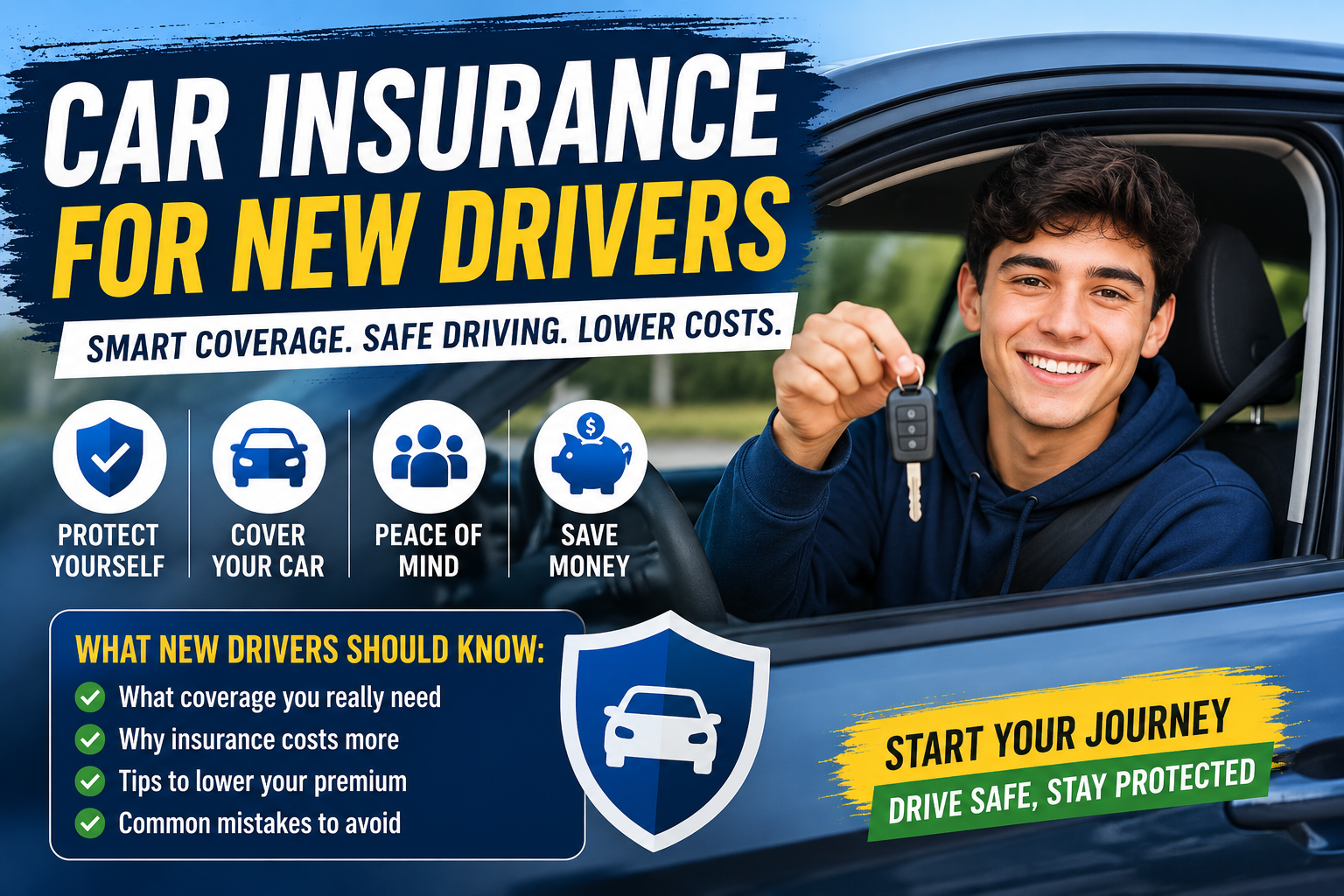
Learn how car insurance for new drivers works, what affects rates, how to save money, and which coverage options beginners should consider.
Getting your first driver’s license is exciting. Getting your first car can be even more exciting. But there is one part of becoming a new driver that many beginners find confusing: car insurance.
New drivers often face higher insurance costs because insurers have limited information about their driving history. A person who has only recently received a license does not have the same proven record as an experienced driver who has spent years driving without accidents or violations.
That does not mean new drivers are stuck paying extremely high premiums forever.
Understanding how insurance works, comparing quotes, choosing appropriate coverage, taking advantage of available discounts, and building a clean driving record can make a significant difference over time.
This guide explains car insurance for new drivers from the basics to more advanced considerations. You’ll learn what coverage you may need, why new drivers often pay more, how insurers calculate premiums, ways to reduce costs, and common mistakes to avoid.
What Is Car Insurance for New Drivers?
Car insurance for new drivers is automobile insurance designed for people who have limited driving experience or are obtaining coverage for the first time.
A new driver may be:
- A teenager who recently received a license
- A young adult buying their first car
- An adult who has recently learned to drive
- Someone who has had a license but little driving experience
- A driver moving to a new country and establishing a local insurance history
- Someone purchasing their first vehicle and insurance policy
Being a new driver does not necessarily mean you are young.
An adult who receives a driver’s license at age 30 may still be considered inexperienced by an insurer because they do not have a long driving history.
Why Is Car Insurance More Expensive for New Drivers?
Insurance companies use risk assessment to determine premiums.
A new driver has limited historical information that can demonstrate how safely they drive. Because there is less evidence about their driving behavior, insurers may consider them higher risk than an experienced driver.
Several factors can influence the price.
Driving Experience
Experience matters because safe driving involves more than knowing traffic rules.
Experienced drivers have typically encountered:
- Heavy traffic
- Bad weather
- Night driving
- Highway driving
- Emergency situations
- Aggressive drivers
- Difficult parking situations
- Unexpected road hazards
A new driver is still developing these skills.
Age
Age can affect insurance rates, particularly for younger drivers.
Young drivers may have less driving experience and can therefore face higher premiums.
However, age and driving experience are not identical.
A 25-year-old who has driven for seven years may have a different risk profile from a 25-year-old who obtained a license recently.
Driving Record
Your driving record can have a significant impact on insurance costs.
A clean record generally provides insurers with evidence of responsible driving.
Tickets, serious violations, and accidents can increase premiums depending on the circumstances and insurer.
Type of Vehicle
The vehicle you drive can also affect your insurance cost.
Factors may include:
- Vehicle value
- Repair costs
- Safety features
- Theft risk
- Engine characteristics
- Crash history
- Replacement cost
- Claims history associated with similar vehicles
A new driver can potentially reduce insurance costs by choosing a practical vehicle instead of an expensive, high-performance model.
What Types of Car Insurance Coverage Do New Drivers Need?
Understanding insurance terminology is important because a policy is made up of different types of coverage.
The exact requirements depend on where you live, but common coverage categories include liability, collision, comprehensive, uninsured or underinsured motorist coverage, and medical-related coverage.
Liability Insurance
Liability insurance generally helps pay for injuries or property damage you cause to other people when you are legally responsible for an accident, subject to the policy limits and terms.
It is one of the most important types of coverage for drivers.
For example, imagine a new driver accidentally hits another vehicle.
If the driver is legally responsible, liability coverage may help with eligible damages to the other person’s vehicle and injuries, up to the policy’s limits.
Bodily Injury Liability
This part of liability coverage generally applies to injuries caused to other people in an accident for which you are responsible.
Property Damage Liability
This generally helps cover eligible damage you cause to someone else’s property, such as another vehicle.
Collision Coverage
Collision coverage generally helps pay for damage to your own vehicle resulting from a covered collision, subject to your deductible and policy terms.
For example, you might hit:
- Another vehicle
- A parked car
- A wall
- A pole
- Another object
Collision coverage can be particularly valuable when your vehicle is relatively expensive or you could not comfortably afford to repair or replace it yourself.
Comprehensive Coverage
Despite its name, comprehensive coverage does not mean your car is covered against absolutely everything.
It generally covers certain non-collision losses, subject to the policy.
Examples can include:
- Theft
- Vandalism
- Falling objects
- Certain weather-related damage
- Fire
- Animal-related damage
Coverage varies by policy.
Uninsured and Underinsured Motorist Coverage
Some drivers operate vehicles without sufficient insurance.
Uninsured or underinsured motorist coverage may provide protection in certain situations involving drivers who have no insurance or insufficient coverage.
Availability and requirements vary by location.
For new drivers, this coverage can be worth understanding because an accident can create significant financial consequences even when another driver is responsible.
Medical Payments or Personal Injury Coverage
Depending on where you live, automobile insurance may include or offer coverage for medical expenses resulting from an accident.
The exact structure varies significantly between jurisdictions.
Review the coverage available in your area rather than assuming every policy works the same way.
Minimum Insurance vs. Full Coverage
One of the biggest decisions for new drivers is whether to purchase only the required minimum coverage or broader protection.
| Feature | Minimum Coverage | Broader Coverage |
|---|---|---|
| Cost | Usually lower | Usually higher |
| Liability protection | Limited to selected limits | Can provide higher limits |
| Own vehicle damage | May not be covered | May include collision/comprehensive |
| Financial protection | More limited | More extensive |
| Best suited to | Lower-value vehicles/budget situations | Higher-value vehicles or greater protection needs |
The cheapest policy is not automatically the best policy.
A policy with very low liability limits can leave you financially exposed after a serious accident.
How Much Car Insurance Does a New Driver Need?
There is no single coverage amount that works for every driver.
At minimum, you need to understand the legally required coverage where you live.
Beyond that, consider:
- Value of your vehicle
- Savings
- Income
- Assets
- Potential liability exposure
- Driving habits
- Loan or lease requirements
- Risk tolerance
If you finance or lease a vehicle, the lender may require specific coverage beyond the legal minimum.
Car Insurance for New Drivers: A Simple Example
Imagine a new driver purchases a $20,000 vehicle.
Choosing only minimum liability coverage may leave the driver without protection for damage to their own vehicle caused by a collision.
If they cause an accident and their vehicle is also damaged, they may have to pay for their own repairs if they do not have appropriate first-party coverage.
A broader policy may cost more, but it can reduce the driver’s financial exposure.
This is why insurance should be evaluated based on risk and affordability, not just the monthly premium.
How Much Does Car Insurance Cost for New Drivers?
There is no universal price for new-driver insurance.
Premiums can vary substantially based on factors such as:
- Age
- Location
- Driving history
- Vehicle
- Coverage limits
- Deductible
- Annual mileage
- Insurance history
- Claims history
- Credit-related insurance factors where legally permitted
- Discounts
- Whether the driver is added to an existing policy
Two new drivers with identical vehicles can receive very different quotes.
That is why comparing several quotes is often more useful than relying on a general average.
How to Get Cheap Car Insurance for New Drivers
New-driver insurance can be expensive, but there are several legitimate strategies that may help lower the cost.
1. Compare Multiple Insurance Quotes
Do not assume the first quote you receive is the best available price.
Insurance companies use different pricing models.
Compare several options using the same:
- Vehicle information
- Coverage limits
- Deductible
- Driver information
- Annual mileage
This makes comparisons more meaningful.
2. Choose Your Vehicle Carefully
The car you buy can have a major effect on your insurance costs.
Before purchasing a vehicle, get insurance quotes for that specific model.
Two cars with similar purchase prices can have very different insurance costs.
A practical vehicle with good safety features may be less expensive to insure than a powerful sports car.
3. Consider a Higher Deductible
A deductible is the amount you generally pay toward a covered claim before the insurer pays the remaining eligible amount.
A higher deductible can sometimes reduce your premium.
However, there is an important trade-off.
If you choose a $1,000 deductible, you should be financially prepared to pay $1,000 toward a covered claim when required.
Do not choose a deductible that would create a financial crisis.
4. Ask About Discounts
Insurance companies may offer discounts for qualifying drivers.
Potential discounts can include:
- Good student discounts
- Defensive driving discounts
- Multi-policy discounts
- Safe-driver discounts
- Low-mileage discounts
- Vehicle safety discounts
- Telematics-based discounts
- Driver training discounts
Discount availability varies by insurer and location.
Always ask what discounts you may qualify for.
Good Student Discounts
Young drivers who maintain strong academic performance may qualify for certain insurance discounts depending on the insurer.
If you are a student, ask your insurer whether academic performance can affect your premium.
Requirements vary.
Defensive Driving Courses
Some insurers offer discounts to drivers who complete approved driver education or defensive driving programs.
Even when a course does not produce a major discount, developing better defensive-driving habits can potentially reduce accident risk.
Telematics and Usage-Based Insurance
Some insurance programs use technology to evaluate driving behavior.
Depending on the program, data may include factors such as:
- Speed
- Braking
- Acceleration
- Mileage
- Time of day
- Driving patterns
Safe driving may lead to savings under some programs.
However, new drivers should understand how the program works before enrolling.
Read the privacy terms, scoring rules, and potential effects on premiums carefully.
Should New Drivers Join a Parent’s Insurance Policy?
For young drivers living with parents, being added to an existing family policy can sometimes be more economical than purchasing a completely separate policy.
The answer depends on:
- Household arrangement
- Insurer rules
- Vehicle ownership
- Driver age
- Location
- Driving record
- Available discounts
Do not assume that a separate policy is automatically cheaper.
Compare both scenarios.
Can a New Driver Use a Parent’s Car?
This depends on the policy, household arrangement, and local rules.
A driver should not assume they are automatically covered simply because they have permission to use a family member’s vehicle.
Insurance policies can contain specific rules about:
- Household members
- Regular vehicle use
- Permissive drivers
- Vehicle ownership
- Primary drivers
The safest approach is to make sure the insurance company knows about regular drivers in the household.
Car Insurance for Teen Drivers
Teen drivers often face particularly high insurance premiums because they combine limited experience with a relatively short driving history.
Parents can potentially reduce costs by:
- Comparing insurers
- Asking about student discounts
- Encouraging defensive driving
- Choosing a practical vehicle
- Maintaining a clean driving record
- Considering telematics programs
- Reviewing coverage regularly
The vehicle choice can be especially important.
Adding an inexperienced driver to a high-performance vehicle can create a very different insurance situation from adding them to a practical family car.
Car Insurance for New Adult Drivers
Not every new driver is a teenager.
An adult who recently obtained a license may also need new-driver insurance.
The same fundamental principles apply:
- Build a clean driving record
- Compare insurers
- Choose a sensible vehicle
- Consider appropriate coverage
- Ask about discounts
- Avoid unnecessary claims
- Drive defensively
An adult new driver may have an advantage in some areas, such as financial stability or a longer credit and insurance history, depending on the insurer’s rating practices.
Car Insurance for First-Time Drivers With No Insurance History
Insurance history and driving history are not necessarily the same thing.
A person can have a valid license but no previous insurance policy.
Insurers may consider prior insurance history when determining eligibility and pricing.
If you have never owned a vehicle or maintained your own insurance policy, explain your situation accurately when requesting quotes.
Do not claim to have insurance experience you do not have.
Car Insurance for New Drivers With an International Driving History
Drivers moving from another country can face a unique challenge.
They may have years of safe driving experience but limited local insurance history.
Some insurers may recognize foreign driving experience, while others may not.
Keep documentation of your previous driving history where possible.
Potentially useful records can include:
- Previous insurance documents
- Claims history
- Driver’s license records
- Official driving history
- Proof of previous coverage
Recognition varies, so compare insurers rather than assuming all companies will treat international experience the same way.
Does Credit Score Affect Car Insurance?
In some jurisdictions, insurers may use credit-based insurance information as one factor in pricing.
The rules differ by location, and some jurisdictions restrict or prohibit certain uses of credit information for insurance.
If this factor applies where you live, improving your overall financial profile may potentially help with insurance costs.
However, it is not the only factor insurers consider.
Why a Clean Driving Record Matters
Your first few years of driving can establish an important insurance history.
Avoid:
- Speeding
- Distracted driving
- Driving under the influence
- Aggressive driving
- Unsafe lane changes
- Unnecessary risky maneuvers
A clean record can help demonstrate responsible driving over time.
More importantly, safe driving protects people.
The goal should not simply be to obtain a lower premium.
The goal is to become a safer driver.
How New Drivers Can Build a Good Driving Record
Practice defensive driving
Do not assume other drivers will behave correctly.
Maintain appropriate following distance and stay alert to potential hazards.
Avoid distractions
Keep your attention on driving.
Common distractions include:
- Texting
- Social media
- Eating
- Adjusting complicated controls
- Excessive passenger interaction
Slow down
Speeding reduces the amount of time you have to react to unexpected situations.
Following speed limits and adjusting speed to road conditions can reduce risk.
Be cautious at night
Night driving can make it more difficult to see hazards and judge distances.
New drivers should build nighttime experience gradually.
Practice in difficult weather
Rain, snow, fog, and strong winds can dramatically change driving conditions.
New drivers should learn how their vehicle responds under different conditions.
Common Mistakes New Drivers Make With Car Insurance
Mistake 1: Choosing the Cheapest Policy
A cheap policy can be attractive when you’re on a budget.
But insufficient coverage can create serious financial exposure.
Always compare coverage, limits, deductibles, and exclusions.
Mistake 2: Not Comparing Quotes
Insurance pricing varies.
The company that gives your friend the cheapest quote may not give you the best price.
Mistake 3: Buying a Car Before Checking Insurance Cost
This is a common mistake.
People often compare purchase prices but forget to compare insurance premiums.
Get insurance estimates before purchasing the vehicle.
Mistake 4: Choosing an Unrealistically High Deductible
A high deductible can lower premiums but increase your out-of-pocket exposure.
Choose a deductible you can actually afford.
Mistake 5: Failing to Report Household Drivers
If another person regularly drives the insured vehicle, hiding that information can create problems.
Be honest with the insurer about regular drivers and vehicle use.
Mistake 6: Assuming Every Accident Is Covered
Coverage depends on the policy.
Exclusions, limits, deductibles, and conditions matter.
Read your policy rather than relying on assumptions.
What Happens If a New Driver Has an Accident?
The process generally begins with making sure everyone is safe and contacting emergency services when necessary.
After that, the driver should follow the applicable accident-reporting and insurance procedures.
Depending on the situation, this may involve:
- Documenting the accident
- Exchanging required information
- Taking photographs when safe
- Reporting the incident to the insurer
- Cooperating with the claims process
- Providing relevant documents
- Reviewing repair or settlement information
A new driver should never panic and attempt to hide an accident from an insurer when reporting is required.
Will One Accident Increase Insurance Rates?
It can.
An at-fault accident may affect future premiums depending on the insurer, severity, claims history, location, and other factors.
Some insurers offer accident forgiveness programs for qualifying customers, but eligibility and terms vary.
The best way to avoid an accident-related premium increase is to maintain safe driving habits.
Can New Drivers Get Full Coverage?
Yes, new drivers can generally purchase broader coverage that includes protection such as collision and comprehensive, depending on the insurer and vehicle.
The fact that someone is a new driver does not automatically prevent them from obtaining full coverage.
However, the premium may be higher because of their driving experience and other risk factors.
Is Full Coverage Worth It for a New Driver?
It depends on the vehicle and financial situation.
Full coverage can make more sense when:
- The vehicle is relatively valuable
- The vehicle is financed
- The vehicle is leased
- You could not afford to replace it
- You want broader protection
It may make less financial sense for an older vehicle with a low market value.
Even then, liability coverage should be considered separately because it protects against a different type of financial risk.
How to Choose a Car That Is Cheaper to Insure
If insurance cost is important, consider a vehicle with:
- Strong safety features
- Moderate repair costs
- Reasonable replacement value
- Good reliability
- Lower theft risk
- A less powerful engine
Before buying, obtain an insurance quote.
This small step can prevent an unpleasant surprise after purchasing the car.
New Driver Insurance: Employee vs. Student Considerations
Insurance companies may classify drivers differently depending on factors such as age, education, occupation, driving history, and household situation.
Students may qualify for certain discounts.
Working adults may have different eligibility criteria.
Never assume you qualify for a discount without checking the insurer’s actual requirements.
How Often Should New Drivers Compare Car Insurance?
There is no universal requirement to switch insurers every year.
However, reviewing your insurance periodically can be worthwhile.
Your premium may change after:
- A new vehicle
- A new address
- A major age milestone
- A clean driving period
- A new household member
- A change in annual mileage
- Changes in available discounts
- Changes in coverage needs
You can compare quotes when your circumstances change rather than switching automatically.
A Simple Car Insurance Comparison Checklist
Before choosing a policy, compare the following:
| Factor | What to Check |
|---|---|
| Premium | Monthly and annual cost |
| Liability | Coverage limits |
| Deductible | Amount you pay before eligible claims are covered |
| Collision | Whether your vehicle is protected |
| Comprehensive | Non-collision risks covered |
| Uninsured motorist | Available protection |
| Discounts | Which ones you qualify for |
| Exclusions | What the policy does not cover |
| Claims process | How claims are handled |
| Vehicle requirements | Whether lender rules apply |
The lowest premium is only one part of the decision.
How to Budget for Car Insurance
If you are buying your first car, don’t calculate affordability using the vehicle payment alone.
Your real transportation budget may include:
- Car payment
- Insurance
- Fuel
- Maintenance
- Registration
- Tires
- Repairs
- Parking
- Taxes and fees
A car that looks affordable based on its purchase price may become expensive when all operating costs are included.
Insurance should be part of your budget before purchasing the vehicle.
How to Save Money as a New Driver Long Term
The biggest savings may come from developing a strong driving and insurance history over time.
Focus on:
Maintain a clean record
Avoid tickets and accidents.
Drive fewer miles when appropriate
If your actual mileage is low, tell your insurer.
Review discounts
Discount programs can change as your circumstances change.
Reconsider your vehicle
When replacing a car, compare insurance costs before buying.
Shop around periodically
Pricing can change as your risk profile changes.
Keep your information accurate
Incorrect information can create complications during underwriting or claims.
Advanced Considerations for New Drivers
Once you understand the basics, consider the broader financial implications of your insurance choices.
Liability Limits Matter
Suppose you cause an accident resulting in significant injuries.
If your liability coverage is insufficient, you may potentially face financial exposure beyond the insurance policy’s limits, depending on the circumstances and applicable law.
This is why choosing liability limits should not be based solely on the minimum required amount.
Asset Protection
People with significant savings, property, or income may have more to lose financially from a serious liability claim.
As your financial situation improves, review whether your liability coverage remains appropriate.
Umbrella Insurance
Some people with substantial assets or higher liability exposure may consider umbrella insurance.
Umbrella policies can provide additional liability protection above certain underlying insurance limits, subject to the policy terms.
They are not necessary for every driver, but they can be relevant to broader financial-risk planning.
Car Insurance for New Drivers: A Practical Strategy
If you’re buying your first car, use this sequence:
Step 1: Determine your budget
Calculate the total monthly cost of owning the vehicle.
Step 2: Choose several potential vehicles
Don’t immediately commit to one model.
Step 3: Get insurance quotes
Compare estimated premiums for each vehicle.
Step 4: Decide on coverage
Consider liability limits, collision, comprehensive, and other relevant coverage.
Step 5: Compare insurers
Obtain multiple quotes using equivalent coverage.
Step 6: Review deductibles
Choose an amount you could realistically afford.
Step 7: Ask about discounts
Check all available discount categories.
Step 8: Read the policy
Understand exclusions and conditions before purchasing.
Step 9: Drive responsibly
Your long-term driving record matters.
Frequently Asked Questions
What is the cheapest car insurance for new drivers?
There is no single insurer that is cheapest for every new driver. Pricing depends on factors such as age, location, vehicle, driving record, coverage, deductible, and discounts. Comparing multiple quotes is one of the best ways to find a competitive rate.
Why is car insurance so expensive for new drivers?
New drivers have limited driving history, giving insurers less evidence about their risk. Age, location, vehicle, coverage level, claims history, and other factors can also affect the premium.
Can a new driver get car insurance?
Yes. New drivers can obtain car insurance, although they may pay more than experienced drivers. The exact price depends on the driver’s circumstances and the insurer.
Do new drivers need full coverage?
Not necessarily. Required coverage depends on local law, while additional coverage depends on the vehicle and the driver’s financial situation. Financed or leased vehicles may have additional coverage requirements.
Can new drivers get discounts?
Potentially. Depending on the insurer and location, discounts may be available for students, defensive driving courses, safe driving, multiple policies, low mileage, vehicle safety features, or usage-based insurance programs.
Is it cheaper for a new driver to join a parent’s insurance?
For some young drivers living with parents, joining an existing household policy can be less expensive than purchasing a separate policy. However, this depends on the insurer, household circumstances, vehicles, and driver information.
Does the type of car affect insurance for new drivers?
Yes. Vehicle value, repair costs, safety features, theft risk, performance characteristics, and other factors can affect premiums. Always compare insurance costs before buying a vehicle.
Can an adult with a new license get affordable car insurance?
Yes. Adult new drivers can find competitive insurance, although limited driving history may still affect premiums. Comparing insurers and building a clean driving record can help over time.
How can I lower my car insurance as a new driver?
Compare quotes, choose a practical vehicle, ask about discounts, consider an appropriate deductible, maintain a clean driving record, and review your coverage periodically.
How long are you considered a new driver?
There is no universal period that applies to every insurer or jurisdiction. An insurer may consider factors such as driving experience, age, insurance history, and claims history rather than simply counting the number of months since licensing.
Does a new driver’s first accident permanently affect insurance?
Not necessarily. The effect of an accident can change over time, depending on the insurer, driving history, accident circumstances, and applicable rules. Maintaining a clean record afterward can improve your insurance profile over time.
Should I buy insurance before buying my first car?
It is wise to investigate insurance costs before purchasing a vehicle. Getting quotes for the vehicles you’re considering can help you understand the true cost of ownership and avoid buying a car that is unexpectedly expensive to insure.
What is the best insurance for a first-time driver?
The best policy is the one that provides appropriate protection at a price you can afford. Compare liability limits, deductibles, collision and comprehensive coverage, exclusions, discounts, and other policy features rather than focusing only on the premium.
Final Conclusion
Getting car insurance for new drivers can feel complicated, especially when you’re seeing higher premiums than experienced drivers.
But the process becomes much easier once you understand what insurers are evaluating.
Your driving experience, age, vehicle, location, insurance history, coverage choices, deductible, and other personal factors can all influence the price. Because insurers use different pricing models, there is no single company or policy that will automatically be cheapest for every new driver.
The most effective strategy is to compare several quotes using the same coverage levels.
At the same time, don’t make the mistake of choosing insurance solely because it has the lowest monthly price. Liability coverage protects you from a potentially serious financial risk, while collision and comprehensive coverage can protect your own vehicle against different types of losses.
For new drivers, the long-term strategy is even more important.
Drive safely. Avoid distractions. Follow traffic laws. Build a clean driving record. Review available discounts. Choose vehicles carefully. Reassess your coverage as your financial situation changes.
Your first insurance policy is only the beginning.
Over time, responsible driving and smart insurance decisions can help you build a stronger financial and driving profile while keeping your coverage aligned with your actual needs.
Actionable Takeaways
- Compare multiple quotes before choosing an insurer.
- Get insurance estimates before buying a car.
- Understand liability coverage rather than automatically choosing the minimum.
- Consider collision and comprehensive coverage based on your vehicle’s value and your finances.
- Ask about every available discount.
- Choose a deductible you can realistically afford.
- Maintain a clean driving record.
- Tell your insurer about regular household drivers.
- Review your policy when your circumstances change.
- Focus on both price and protection, not price alone.
The goal isn’t simply to find the cheapest car insurance for a new driver. The goal is to find affordable coverage that protects you from the financial consequences of an accident while giving you a strong foundation for the years ahead.