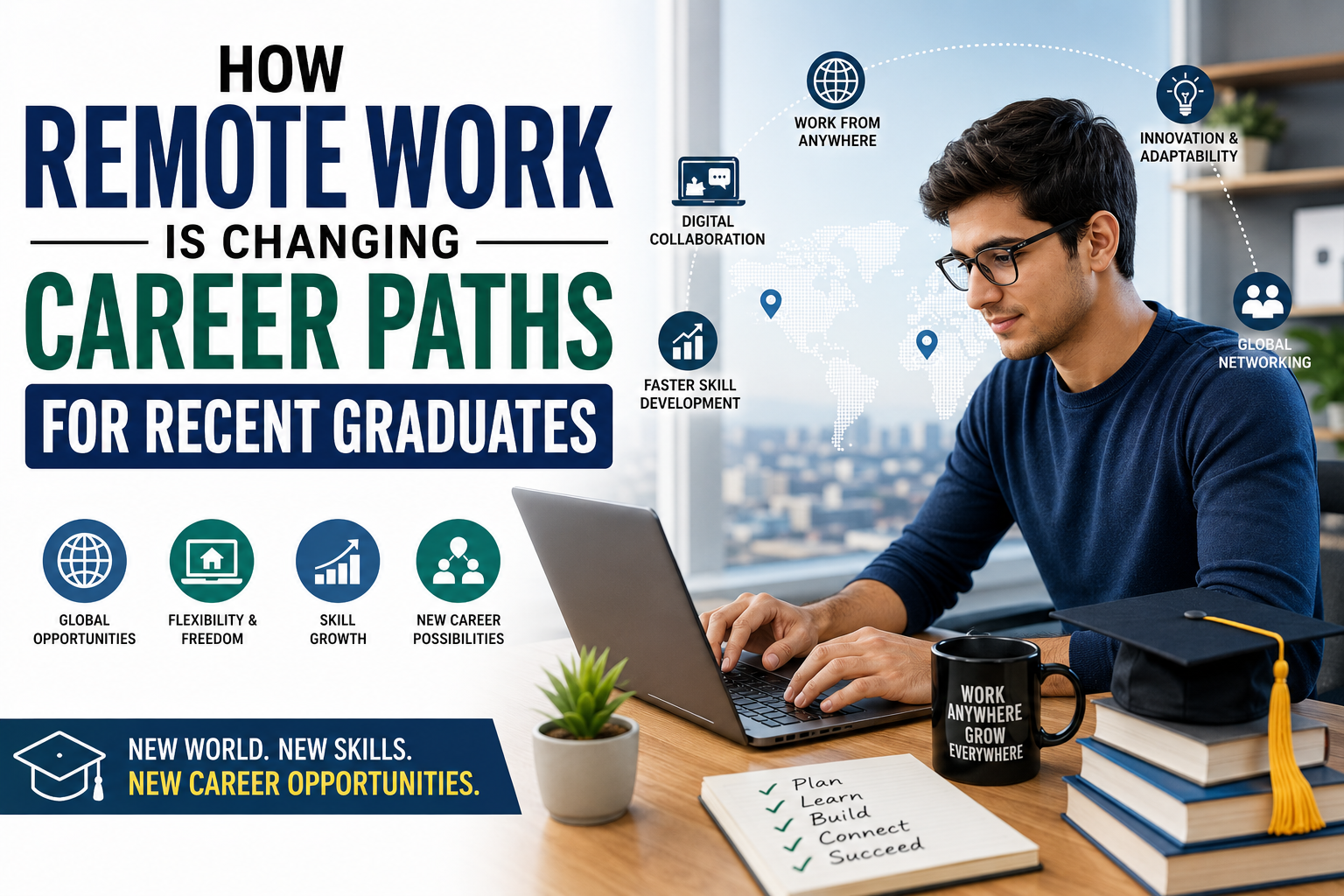
Discover how remote work is changing career paths for recent graduates, from first jobs and skills to networking, career growth, and long-term success.
Suggested URL Slug: how-remote-work-is-changing-career-paths-for-recent-graduates
remote work for recent graduates
Graduating from college or university used to follow a fairly predictable pattern: earn a degree, create a resume, attend interviews, accept an entry-level position, and begin climbing the traditional career ladder.
That model is changing.
Remote work has introduced a different way for recent graduates to start and build their careers. Instead of being limited to employers within commuting distance, graduates can potentially compete for opportunities across cities, regions, and even countries. They can work from home, collaborate with distributed teams, gain experience through freelance projects, and develop specialized skills without necessarily following a traditional office-based career path.
This shift creates exciting opportunities, but it also introduces new challenges.
A graduate may have more choices than ever before, yet competition can also be global. Networking can happen through digital communities rather than office conversations. Professional visibility must often be created intentionally. And skills that were once considered secondary—such as written communication, digital collaboration, self-management, and online networking—have become increasingly important.
Understanding remote work for recent graduates therefore requires looking beyond the idea of simply working from home.
Remote work is changing how graduates enter careers, how they develop skills, how employers evaluate talent, and how professionals define career progression.
This guide explores those changes in detail and explains how graduates can use remote opportunities strategically rather than treating remote work as merely a convenient alternative to an office job.
What Is Remote Work?
Remote work is a work arrangement in which employees or independent professionals perform their responsibilities outside a traditional centralized workplace.
Depending on the organization, remote work may be:
- Fully remote
- Partially remote
- Hybrid
- Location-independent
- Project-based
- Freelance or contract-based
A fully remote employee may work from home every day. A hybrid employee may divide time between home and an office. A freelancer may work remotely for several clients rather than having a single employer.
For recent graduates, this distinction matters because remote work can affect career development differently depending on the arrangement.
Quick definition
Remote work allows professionals to perform job responsibilities away from a traditional office, usually through digital communication, collaboration, and productivity tools.
For graduates, the biggest change is not simply the location of work.
It is the expanded range of possible career paths.
Why Remote Work Matters for Recent Graduates
Recent graduates often face a difficult transition.
They may have academic knowledge but limited professional experience. They need to demonstrate their value while competing against candidates who already have years of workplace experience.
Remote work changes this equation in several ways.
Graduates can potentially access:
- Employers outside their immediate geographic area
- Remote internships
- Freelance projects
- Contract positions
- Digital apprenticeships
- International teams
- Online professional communities
- Skill-based career opportunities
This can make the first stage of a career more flexible.
At the same time, remote work does not eliminate the traditional challenges of entering the workforce.
Graduates still need:
- Relevant skills
- A strong resume
- Professional communication
- Evidence of ability
- Interview preparation
- Networking
- Consistency
- Adaptability
The difference is that many of these activities now happen digitally.
How Remote Work Is Changing Career Paths
Remote work is influencing careers in several major ways.
1. Geography Matters Less
One of the most significant changes is the reduced importance of physical location.
In a traditional job search, a graduate might focus on companies within commuting distance.
Remote work can expand that search.
A graduate living in a smaller city may potentially work for an organization headquartered in another city or country without relocating.
Traditional career model
Education → Local job → Office → Promotion → Relocation if necessary
Remote career model
Education → Online applications → Remote role → Digital collaboration → Skill development → Broader career opportunities
The second model does not apply to every profession, but it demonstrates how geography can become less restrictive.
2. The First Job Is Becoming More Flexible
Graduates no longer necessarily have to begin their professional lives with a conventional full-time office position.
Alternative starting points include:
- Remote internships
- Freelance projects
- Part-time remote jobs
- Contract work
- Apprenticeships
- Temporary assignments
- Digital consulting
- Online tutoring
- Project-based employment
This creates more entry points into professional work.
For example, a marketing graduate might begin by managing social media for a small business, create a portfolio, and later move into a remote digital marketing position.
A computer science graduate could contribute to open-source projects, build applications, and use those projects as evidence of technical ability when applying for remote development positions.
The career begins with demonstrated capability, not necessarily with a traditional corporate title.
3. Skills Can Matter More Than Location
Remote employers often care about whether someone can perform the job effectively.
This increases the importance of demonstrable skills.
A graduate may have limited professional experience but still stand out through:
- Strong portfolio projects
- Technical certifications
- Practical assignments
- Freelance experience
- Internship experience
- Personal projects
- Industry knowledge
- Strong communication
This creates an important lesson:
A degree can open a door, but practical skills can help you stay competitive after you enter.
Graduates should therefore avoid relying exclusively on academic credentials.
Instead, they should connect education with practical application.
4. Digital Skills Are Becoming Career Skills
Remote work depends heavily on technology.
Even professionals who do not work in technology-related careers increasingly need digital competence.
Common tools and skills include:
- Video conferencing
- Project management software
- Cloud documents
- Team messaging
- Digital calendars
- Online presentations
- Collaborative editing
- File management
- Basic cybersecurity awareness
- Data organization
However, digital skills go beyond knowing how to operate software.
A strong remote worker understands how to communicate and collaborate digitally.
For example, instead of sending:
“I finished it.”
A professional might provide a concise update explaining:
- What was completed
- What remains
- Any problems encountered
- What happens next
That difference may appear small, but effective digital communication can significantly improve remote collaboration.
5. Career Paths Are Becoming More Skill-Based
Traditional careers often follow recognizable ladders.
For example:
Junior Accountant → Accountant → Senior Accountant → Manager
Remote work can create more varied pathways.
A graduate might move from:
Marketing Assistant → SEO Specialist → Content Strategist → SEO Manager → Independent Consultant
Or:
Junior Designer → Freelance Designer → Brand Designer → Creative Lead → Design Consultant
The path is not always linear.
Professionals can move sideways to develop new skills before moving upward.
This means recent graduates should think about careers as skill portfolios, not just job titles.
Remote Work and the Rise of Portfolio Careers
A portfolio career involves combining different professional activities rather than relying entirely on one traditional position.
For example, someone might simultaneously:
- Work part-time for a company
- Freelance for two clients
- Teach online
- Build a personal project
- Create professional content
Not everyone needs a portfolio career, and some graduates will prefer stable full-time employment.
But remote work makes multiple income and experience streams more practical for some professionals.
Example
Imagine a recent graphic design graduate.
Instead of waiting months for a traditional design position, they might:
- Build a design portfolio.
- Take small freelance projects.
- Work part-time remotely.
- Create branding samples.
- Develop expertise in a specific industry.
- Apply for full-time remote design positions.
- Eventually offer specialized consulting services.
The career develops through several connected experiences.
Remote Work Is Changing What Employers Look For
Remote hiring requires employers to evaluate candidates differently.
In an office environment, managers can observe employees naturally throughout the workday.
Remote managers cannot rely on physical visibility.
As a result, employers may place greater emphasis on qualities such as:
- Self-management
- Written communication
- Reliability
- Time management
- Accountability
- Digital collaboration
- Problem-solving
- Independence
- Adaptability
For recent graduates, this is important because many of these skills can be demonstrated even without extensive professional experience.
The Most Important Skills for Remote Graduates
1. Communication
Communication is one of the most valuable remote-work skills.
Graduates should learn how to communicate clearly through:
- Chat
- Video meetings
- Project management systems
- Presentations
- Documentation
Remote communication should be concise but complete.
2. Time Management
Without constant physical supervision, employees need to manage their own workload.
Important habits include:
- Setting priorities
- Creating schedules
- Breaking large tasks into smaller tasks
- Meeting deadlines
- Tracking assignments
- Avoiding unnecessary distractions
Time management is not about working every minute.
It is about consistently completing important work on time.
3. Self-Discipline
Remote workers often have more freedom.
That freedom can become either an advantage or a disadvantage.
A successful graduate needs to create boundaries between:
Work time and personal time.
Without structure, distractions can easily reduce productivity.
4. Adaptability
Remote workplaces change quickly.
A company may introduce a new tool, change communication processes, reorganize teams, or alter project priorities.
Graduates who learn quickly can become valuable members of distributed teams.
5. Problem-Solving
Remote employees cannot always walk over to a colleague’s desk and immediately ask for help.
They need to investigate problems independently before escalating them.
A strong approach is:
- Identify the problem.
- Review available information.
- Attempt reasonable solutions.
- Document what was tried.
- Ask a specific question if assistance is needed.
This demonstrates initiative rather than passive dependence.
How Remote Work Is Changing Networking
Networking has traditionally been associated with conferences, offices, university events, and face-to-face meetings.
Remote work expands networking into digital environments.
Graduates can build professional relationships through:
- Online communities
- Virtual events
- Professional groups
- Industry discussions
- Digital portfolios
- Webinars
- Remote internships
- Professional social platforms
- Collaborative projects
The key is to approach networking as relationship building rather than simply asking strangers for jobs.
A better networking strategy
Instead of immediately saying:
“Can you give me a job?”
A graduate can:
- Ask thoughtful questions
- Share useful insights
- Discuss industry trends
- Comment constructively
- Show relevant work
- Learn from experienced professionals
- Maintain professional relationships
Networking becomes much more effective when the interaction provides value to both sides.
Why Online Visibility Matters More
Remote employers cannot physically observe your presence in a workplace.
Your professional reputation may therefore depend more heavily on your digital footprint.
That can include:
- Resume
- Portfolio
- Professional profile
- Published work
- GitHub projects
- Design samples
- Writing samples
- Certifications
- Professional communication
This does not mean every graduate needs to become a social media influencer.
It means that your online professional presence should communicate what you can do.
Remote Work Creates New Opportunities for Introverts
Traditional networking can be difficult for people who dislike large social environments.
Remote work does not eliminate networking, but it can provide different ways to participate.
For example, someone may be more comfortable:
- Writing a thoughtful message
- Participating in online discussions
- Sharing project work
- Attending virtual meetings
- Communicating through professional communities
This can allow some graduates to demonstrate expertise without relying entirely on face-to-face interaction.
However, remote work still requires communication.
Being introverted does not remove the need to communicate professionally.
Remote Internships Are Changing Early Career Experience
Internships have traditionally required students and graduates to physically attend an organization’s workplace.
Remote internships can provide another route.
A remote internship can expose a graduate to:
- Real projects
- Professional communication
- Team collaboration
- Business processes
- Client requirements
- Deadlines
- Digital tools
However, graduates should evaluate internships carefully.
A good internship should provide meaningful learning and professional exposure rather than simply assigning repetitive tasks without development opportunities.
How Remote Work Can Accelerate Career Development
Remote work can accelerate career growth when graduates intentionally use it to build valuable experience.
Suppose two graduates have similar degrees.
Graduate A
Gets an entry-level job and performs only assigned tasks.
Graduate B
Gets an entry-level remote position while deliberately learning:
- Data analysis
- Project management
- Communication
- Industry software
- Presentation skills
After several years, Graduate B may have a broader professional skill set.
The lesson is not that remote workers automatically advance faster.
The lesson is that remote work can provide opportunities for self-directed skill development, but the graduate must actively take advantage of them.
Potential Disadvantages of Remote Work for Graduates
Remote work is not perfect.
Recent graduates can face several challenges.
1. Limited Mentorship
An office environment can create spontaneous learning opportunities.
A junior employee may overhear a conversation, ask a quick question, or learn by observing experienced colleagues.
Remote employees may need to deliberately request mentorship.
2. Less Social Interaction
Working from home can become isolating.
Graduates who are used to university environments may miss:
- Informal conversations
- Team lunches
- Office events
- Casual networking
- Social interaction
This makes it important to maintain professional and personal relationships outside daily work tasks.
3. Visibility Challenges
A remote employee can sometimes become less visible to management.
Simply being busy does not guarantee that leadership recognizes your contributions.
Remote professionals should therefore communicate achievements clearly.
For example:
Completed the project two days early and resolved three major implementation issues.
This gives managers useful information without unnecessary self-promotion.
4. Blurred Work-Life Boundaries
When the office is also your bedroom, kitchen, or living room, switching off can become difficult.
Graduates should establish boundaries such as:
- Defined work hours
- A dedicated workspace
- Scheduled breaks
- Notifications management
- A clear end-of-day routine
Remote Work vs Traditional Office Careers
Both models can provide successful careers.
| Factor | Remote Work | Traditional Office |
|---|---|---|
| Location flexibility | High | Lower |
| Commuting | Minimal or none | Usually required |
| Digital communication | Very important | Important |
| Face-to-face interaction | Lower | Higher |
| Geographic opportunities | Potentially broader | More location-dependent |
| Self-management | Very important | Important |
| Informal networking | Less frequent | More frequent |
| Work environment | Self-managed | Employer-provided |
| Flexibility | Often higher | Varies |
| Career development | More self-directed | Often more structured |
Neither approach is universally superior.
The right choice depends on the individual’s personality, profession, goals, and preferred working environment.
How Graduates Can Prepare for a Remote Career
Step 1: Identify Your Career Direction
Do not start by asking:
“What remote job can I get?”
Ask:
“What valuable problem can I learn to solve remotely?”
This produces better long-term decisions.
Potential fields include:
- Software development
- Digital marketing
- SEO
- Graphic design
- Writing
- Data analysis
- Customer support
- Project management
- Finance
- Sales
- Education
Step 2: Develop One Marketable Skill
Choose one primary skill and become competent.
For example:
Writing + SEO
or
Design + Branding
or
Programming + Web Development
or
Marketing + Analytics
Combining related skills can create a stronger professional profile.
Step 3: Create Practical Projects
Do not wait until an employer gives you experience.
Create it yourself.
A graduate can build:
- A personal website
- A sample marketing campaign
- A software application
- A data dashboard
- A design portfolio
- A research report
- A content strategy
- A financial analysis
Projects demonstrate initiative.
Step 4: Build a Professional Portfolio
Your portfolio should answer one question:
“What can this person actually do?”
Avoid filling it with every project you have ever completed.
Instead, select your strongest examples.
For each project, explain:
- The problem
- Your role
- Your approach
- Tools used
- Result
- What you learned
This makes a portfolio much more persuasive.
Step 5: Improve Your Resume for Remote Roles
A remote-focused resume should highlight:
- Relevant skills
- Independent work
- Digital tools
- Communication
- Results
- Projects
- Remote experience
- Technical knowledge
Use measurable achievements where possible.
Instead of:
Helped with marketing.
Consider:
Developed and scheduled a monthly content campaign targeting three customer segments.
Specific descriptions are more informative.
Step 6: Practice Remote Interviews
Remote interviews can include:
- Video interviews
- Recorded interviews
- Online assessments
- Technical tests
- Portfolio reviews
Practice explaining your experience clearly.
If you lack professional experience, discuss projects.
Explain:
What you built → Why you built it → How you approached it → What you learned
That can demonstrate maturity even early in your career.
Remote Career Paths for Different Graduates
Remote opportunities vary considerably by academic background.
Business Graduates
Potential paths include:
- Digital marketing
- Sales
- Customer success
- Operations
- Business analysis
- Project coordination
- Recruiting
Computer Science Graduates
Potential paths include:
- Software development
- Web development
- Data analysis
- Cybersecurity
- Cloud computing
- QA engineering
Design Graduates
Potential paths include:
- Graphic design
- UX/UI design
- Brand design
- Product design
- Motion graphics
- Creative direction
Communications Graduates
Potential paths include:
- Content writing
- Copywriting
- Social media
- Public relations
- Content strategy
- Marketing
Finance Graduates
Potential paths include:
- Accounting
- Bookkeeping
- Financial analysis
- Financial operations
- Business analysis
Education Graduates
Potential paths include:
- Online teaching
- Curriculum development
- Instructional design
- Educational content
- Online tutoring
The degree does not necessarily determine the final career.
It provides a foundation that can be combined with marketable digital skills.
How AI Is Affecting Remote Careers for Graduates
Artificial intelligence is also changing entry-level work.
Some repetitive tasks can increasingly be automated or accelerated.
This means graduates should not build their careers around performing only routine tasks.
Instead, develop skills involving:
- Critical thinking
- Strategy
- Communication
- Problem-solving
- Creativity
- Research
- Decision-making
- AI-assisted productivity
The goal should not be to compete against technology by doing repetitive work faster.
The goal is to learn how to use technology to produce better outcomes.
For example, a content professional can use AI to accelerate research and brainstorming while relying on human judgment for accuracy, positioning, editing, originality, and strategy.
The Future of Entry-Level Remote Work
The entry-level market is likely to continue evolving.
Organizations can increasingly use digital tools to collaborate with employees across locations.
At the same time, companies may become more selective about entry-level candidates because remote hiring can attract applicants from much larger talent pools.
This creates an important paradox:
Remote work expands access while potentially increasing competition.
A graduate may be able to apply for more jobs, but each opportunity may also attract more candidates.
That is why generic applications are becoming less effective.
Graduates need to differentiate themselves through:
- Relevant skills
- Strong portfolios
- Targeted applications
- Clear communication
- Practical experience
- Professional specialization
How Graduates Can Stand Out in a Global Remote Job Market
Demonstrate, Don’t Just Claim
Instead of saying:
“I am good at SEO.”
Show an SEO project.
Instead of:
“I am a good designer.”
Show your design work.
Instead of:
“I know programming.”
Build an application.
Evidence is powerful because it reduces uncertainty for employers.
Develop a T-Shaped Skill Set
A T-shaped professional has:
- Broad knowledge across related areas
- Deep expertise in one particular area
For example, a digital marketer might understand:
- SEO
- Social media
- Email marketing
- Analytics
while specializing deeply in SEO.
This creates flexibility without turning the professional into a generalist who lacks meaningful expertise.
Why Professional Reputation Matters
Remote careers can become increasingly dependent on reputation.
When employers cannot meet you physically, they may rely on:
- Your previous work
- Recommendations
- Portfolio
- Communication
- Professional profiles
- Project results
A strong reputation can create opportunities beyond traditional applications.
A former client may recommend you.
A colleague may introduce you to another company.
A manager may invite you to join a new project.
Therefore, every professional interaction can contribute to your long-term career capital.
Common Mistakes Recent Graduates Make With Remote Work
Mistake 1: Searching Only for “Remote Jobs”
Remote is a work arrangement, not a profession.
Instead of searching only for remote jobs, identify your target profession first.
For example:
SEO Specialist + Remote
is more useful than simply:
Remote Job
Mistake 2: Expecting a High Salary Immediately
Remote work does not automatically mean high income.
Your initial salary may be modest.
Focus on gaining:
- Experience
- Skills
- Results
- Professional connections
These can improve future opportunities.
Mistake 3: Ignoring Networking
Remote does not mean isolated from the professional world.
Networking remains important.
It simply happens through different channels.
Mistake 4: Having No Portfolio
For many skill-based careers, a portfolio can significantly strengthen your application.
If you have no professional projects, create practice projects.
Mistake 5: Applying Without Customization
A generic resume sent to every employer is rarely the strongest strategy.
Adjust your application to the position.
Highlight the experience and skills that directly relate to the job.
A 90-Day Remote Career Plan for Recent Graduates
A structured 90-day strategy can make the transition easier.
Days 1–30: Foundation
Focus on:
- Selecting a career direction
- Learning core skills
- Improving your resume
- Studying your target industry
- Creating your first project
Goal
Build a foundation rather than immediately chasing income.
Days 31–60: Portfolio and Experience
Create:
- Two to four strong projects
- A professional portfolio
- A clear professional profile
- A focused resume
Begin networking and applying for suitable internships, jobs, or freelance opportunities.
Goal
Create evidence that you can perform the work.
Days 61–90: Job Search and Improvement
Track applications.
Analyze interviews.
Improve weak areas.
Continue networking.
Complete additional projects when useful.
Goal
Turn your skills into actual professional opportunities.
Long-Term Career Strategy for Remote Professionals
Getting the first remote job is only the beginning.
Think about the next three stages.
Stage 1: Entry
Build foundational experience.
Stage 2: Specialization
Develop expertise in a valuable area.
Stage 3: Leverage
Use experience to access:
- Senior positions
- Management
- Consulting
- Freelancing
- Entrepreneurship
- Specialized roles
This prevents your career from becoming stuck at the entry level.
Frequently Asked Questions
How is remote work changing career paths for recent graduates?
Remote work is expanding career options beyond local employers and traditional office positions. Graduates can pursue remote employment, freelance projects, internships, contract work, and international opportunities while building careers around specialized skills.
Is remote work good for recent graduates?
Remote work can be beneficial for recent graduates because it may provide flexibility, access to broader job markets, and opportunities to develop digital skills. However, graduates must be proactive about networking, mentorship, communication, and career development.
Can recent graduates get remote jobs without experience?
Yes. Some remote employers offer entry-level positions, internships, and training opportunities. Graduates can also create practical projects or complete freelance work to demonstrate skills when they have limited professional experience.
What skills do graduates need for remote work?
Important skills include communication, time management, self-discipline, adaptability, digital collaboration, problem-solving, and technical skills relevant to the chosen profession.
Does remote work reduce career growth?
Not necessarily. Remote work can provide excellent career growth, but professionals often need to manage their development more intentionally. Networking, communication, visibility, mentorship, and continuous learning are particularly important.
Is remote work better than working in an office?
Neither is universally better. Remote work offers flexibility and geographic freedom, while office work can provide more face-to-face interaction, informal learning, and networking. The best arrangement depends on the individual and profession.
How can a graduate stand out when applying for remote jobs?
Create a strong portfolio, develop relevant skills, customize applications, demonstrate practical experience, communicate clearly, and show evidence of your ability rather than relying solely on academic credentials.
Can remote work help graduates build international careers?
Yes. Some remote positions allow professionals to work with organizations or clients located outside their immediate geographic area. However, eligibility, employment regulations, time zones, payment arrangements, and company policies can vary.
Are remote internships useful?
A well-designed remote internship can provide valuable professional experience, exposure to real projects, digital collaboration skills, and industry knowledge. Graduates should evaluate the quality of the work and learning opportunities before accepting an internship.
What is the biggest challenge of remote work for new graduates?
One major challenge is the lack of informal learning and networking that can occur naturally in an office. New graduates may need to deliberately seek feedback, mentorship, relationships, and professional visibility.
Will AI reduce remote job opportunities for graduates?
AI may automate some repetitive tasks while increasing the value of skills such as critical thinking, strategy, creativity, communication, and problem-solving. Graduates who learn to use AI effectively can potentially become more productive and competitive.
How should graduates prepare for the future of remote work?
Graduates should develop one strong specialization while maintaining broader digital, communication, and problem-solving abilities. Building a portfolio, learning continuously, networking online, and gaining practical experience can help prepare them for changing career requirements.
Conclusion: Remote Work Is Changing the Definition of a Career
Remote work is doing more than moving employees from offices to home offices.
It is changing how recent graduates enter the workforce, develop skills, build professional relationships, and progress through their careers.
The traditional career ladder is becoming only one possible route.
A graduate might start with an internship, move into a remote entry-level position, develop a specialization, freelance on the side, join an international team, transition into consulting, or eventually build a business.
That flexibility can be powerful.
But flexibility also creates responsibility.
Remote professionals must take greater ownership of their development. They need to communicate effectively, build professional relationships, demonstrate their skills, maintain visibility, and continue learning as technology and employer expectations change.
The biggest advantage of remote work for graduates is therefore not simply working from home.
It is the ability to build a career around skills, experience, relationships, and results rather than geography alone.
Actionable Takeaways for Recent Graduates
- Choose a career direction before searching for jobs.
- Develop at least one marketable specialization.
- Build practical projects before waiting for professional experience.
- Create a portfolio that demonstrates what you can actually do.
- Learn digital communication and collaboration.
- Treat networking as relationship building, not job begging.
- Improve your resume for each relevant opportunity.
- Practice remote interviews and professional communication.
- Use AI and digital tools to improve productivity rather than relying on them blindly.
- Seek mentorship and feedback deliberately.
- Continue learning after getting your first remote position.
- Think about your career as a collection of valuable skills, not just job titles.
Remote work does not guarantee career success. But for graduates who approach it strategically, it can provide a broader starting point, greater flexibility, and new ways to turn skills into long-term professional opportunities.