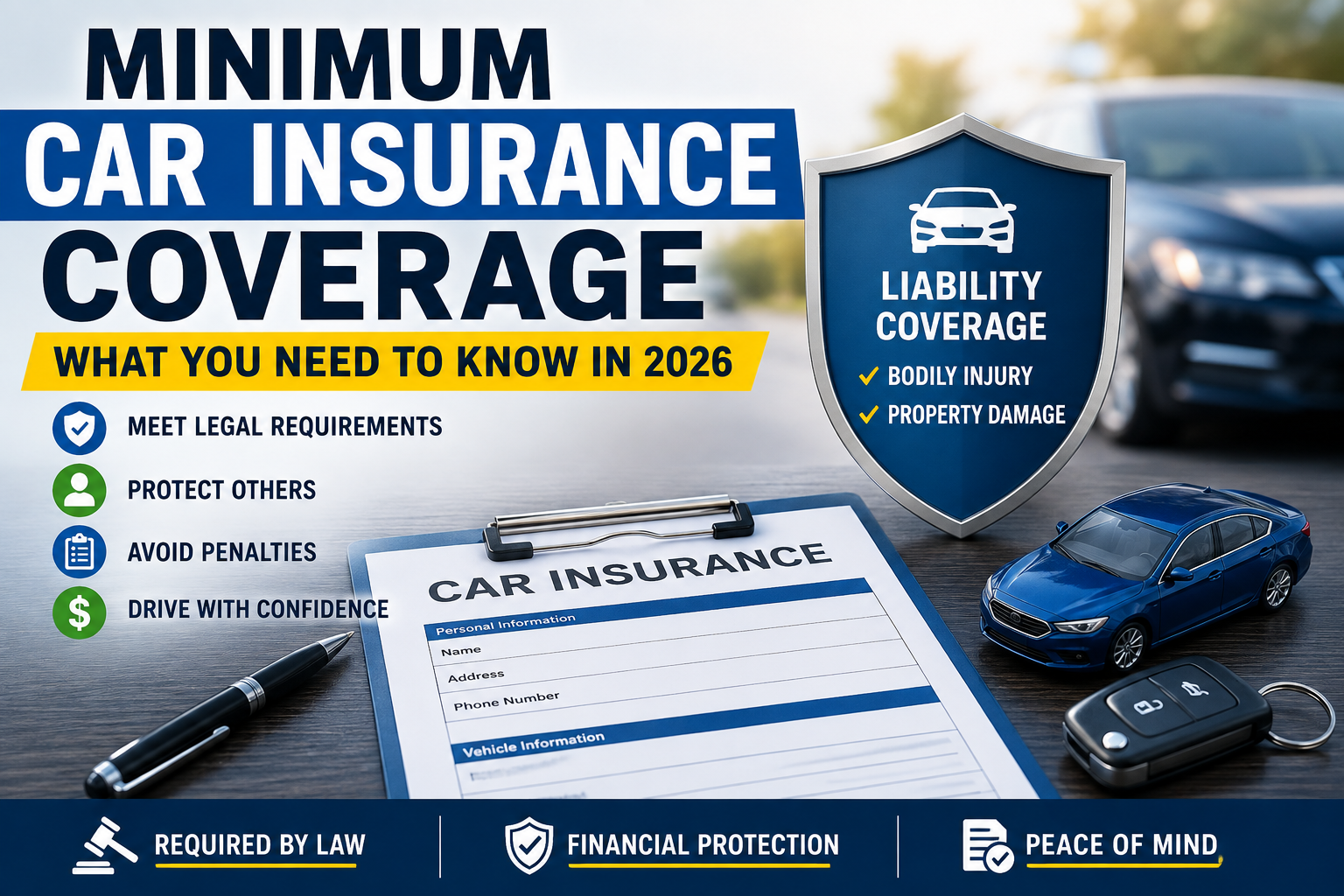
Learn what minimum car insurance coverage means, what each state requires, what it covers, its risks, costs, and whether minimum coverage is enough.
Minimum Car Insurance Coverage: A Complete Guide
Buying car insurance can be confusing, especially if you are a first-time driver or recently purchased a vehicle. You may see terms such as liability coverage, bodily injury, property damage, collision, comprehensive coverage, uninsured motorist protection, deductibles, and policy limits.
But one question usually comes first:
What is the minimum car insurance coverage I legally need?
The answer depends on where you live.
In the United States, car insurance requirements are generally determined at the state level, which means the minimum coverage required in California may be different from the minimum required in Texas, Florida, New York, or another state.
Minimum car insurance coverage is designed to satisfy the legal financial-responsibility requirements for driving. However, meeting the legal minimum does not necessarily mean you have enough protection after an accident.
A policy can technically be legal while still leaving you responsible for thousands or even tens of thousands of dollars in expenses.
This guide explains what minimum car insurance coverage means, how liability limits work, what different types of coverage do, why state requirements differ, the advantages and disadvantages of carrying only minimum coverage, and when increasing your limits may be a smarter financial decision.
What Is Minimum Car Insurance Coverage?
Minimum car insurance coverage is the smallest amount and type of auto insurance protection that a driver must generally maintain to legally operate a vehicle under their state’s financial-responsibility laws.
The exact requirements vary by state.
In many states, the minimum required policy includes some form of liability insurance. Liability coverage helps pay for injuries or property damage that you cause to other people when you are legally responsible for an accident.
For example, imagine you accidentally run a red light and hit another vehicle.
If the other driver suffers injuries and their vehicle is damaged, your liability insurance may help pay their covered losses, up to your policy limits.
However, minimum insurance generally does not mean that every expense associated with your own vehicle or injuries will automatically be covered.
That distinction is extremely important.
Simple Definition
Minimum car insurance coverage is the legally required level of auto insurance protection a driver must carry in their state, subject to that state’s specific laws and requirements.
The legal minimum is a starting point—not necessarily the amount of insurance that provides adequate financial protection.
Why Do States Require Car Insurance?
Car accidents can create substantial financial losses.
A single accident can involve:
- Vehicle repairs
- Medical bills
- Emergency transportation
- Lost wages
- Property damage
- Legal expenses
- Long-term medical treatment
- Rehabilitation
- Damage to other property
Without insurance or another legally accepted form of financial responsibility, an at-fault driver could potentially have to pay qualifying damages out of their own assets.
State insurance requirements are intended to help ensure that drivers have at least some financial protection available when they cause damage to others.
The specific rules differ because each state establishes its own insurance and financial-responsibility framework.
How Minimum Car Insurance Limits Work
One of the most important concepts in auto insurance is the policy limit.
Suppose you see coverage written as:
25/50/25
These numbers generally represent:
- $25,000 bodily injury liability per person
- $50,000 bodily injury liability per accident
- $25,000 property damage liability per accident
The exact minimum limits required depend on the state.
Understanding the Three Numbers
First Number: Bodily Injury Per Person
This is the maximum amount your insurer would generally pay for covered bodily injury claims for one person, subject to the policy and circumstances.
Second Number: Bodily Injury Per Accident
This is the maximum amount available for covered bodily injury claims arising from one accident, regardless of how many injured people are involved, subject to the policy terms.
Third Number: Property Damage
This is the maximum amount available for covered property damage you cause in an accident.
Example of Minimum Liability Coverage
Imagine a driver has liability limits of:
25/50/25
The driver causes an accident involving two people.
One injured person has $20,000 in covered bodily injury damages.
The second person has $15,000.
The total is $35,000.
The policy’s per-person limit is $25,000, while its per-accident bodily injury limit is $50,000.
Assuming the claims are covered, both claims could potentially fit within those limits.
Now imagine one person’s covered damages are $40,000.
The $25,000 per-person limit could leave a $15,000 difference that the driver may remain personally responsible for, depending on the circumstances and applicable law.
This is why simply asking, “What is the cheapest legal car insurance?” is not always enough.
You should also ask:
“How much financial risk am I willing to keep myself?”
What Does Liability Car Insurance Cover?
Liability insurance generally protects you when you are legally responsible for causing covered injury or property damage to another party.
It commonly consists of two major categories.
Bodily Injury Liability
Bodily injury liability coverage can help pay covered costs associated with injuries you cause to other people in an accident for which you are legally responsible.
Potential expenses may include:
- Medical treatment
- Hospital expenses
- Rehabilitation
- Lost income
- Certain legal costs
- Other damages depending on the circumstances and applicable law
It generally does not function as health insurance for your own injuries.
Property Damage Liability
Property damage liability can help pay for covered damage you cause to someone else’s property.
For example, you cause an accident and damage:
- Another vehicle
- A fence
- A building
- A utility structure
- Other property
Your property damage liability coverage may help pay covered repair or replacement costs, up to the policy limit.
What Minimum Liability Insurance Usually Does Not Cover
This is where many new drivers misunderstand minimum coverage.
If your state requires liability insurance and you buy only that minimum liability policy, it generally does not provide the same protection as a full-coverage policy.
Depending on your policy and state, minimum liability insurance may not cover:
- Damage to your own car caused by an accident you caused
- Theft of your vehicle
- Hail damage
- Flood damage
- Certain animal collisions
- Fire damage
- Your own medical expenses
- Damage caused by an uninsured driver unless you have applicable coverage
- Rental transportation after an accident
Other coverage types may address some of these situations.
Minimum Car Insurance vs Full Coverage
The phrase “full coverage” can be misleading because there is no single universal insurance product called full coverage that covers absolutely everything.
People commonly use the term to describe a policy that includes liability insurance plus collision and comprehensive coverage.
| Feature | Minimum Liability | Broader Coverage |
|---|---|---|
| Bodily injury liability | Usually included where required | Usually included |
| Property damage liability | Usually included where required | Usually included |
| Damage to your car from collision | Usually not included | May be included |
| Theft | Usually not included | May be included through comprehensive |
| Hail damage | Usually not included | May be included through comprehensive |
| Fire damage | Usually not included | May be included through comprehensive |
| Uninsured motorist protection | Depends on state/policy | May be included |
| Deductibles | Usually not applicable to liability | Often applies to physical damage coverage |
| Monthly premium | Usually lower | Usually higher |
The exact combination depends on your insurer, state, policy and selected limits.
Collision Coverage
Collision coverage generally helps pay for damage to your own vehicle resulting from a covered collision, subject to your deductible and policy terms.
For example:
You accidentally hit another car.
Your vehicle requires $8,000 in repairs.
If you have collision coverage with a $1,000 deductible, the insurer may pay the covered amount above your deductible, subject to the policy.
Your liability coverage addresses damage you caused to the other party.
Collision coverage addresses covered damage to your vehicle.
Comprehensive Coverage
Comprehensive coverage generally protects against certain non-collision events.
Depending on the policy, examples can include:
- Theft
- Vandalism
- Fire
- Hail
- Falling objects
- Certain animal-related damage
- Weather-related damage
For example, suppose a severe hailstorm damages your car.
Liability insurance generally would not pay to repair your vehicle.
Comprehensive coverage may help, subject to the policy and deductible.
Do All States Have the Same Minimum Car Insurance Requirements?
No.
This is one of the most important facts to understand.
Each state has its own rules regarding financial responsibility and required insurance coverage.
Some states require traditional liability insurance.
Other states have additional requirements.
Some jurisdictions also use different insurance structures that can affect what coverage drivers need.
Therefore, there is no single nationwide minimum car insurance policy that applies identically to every driver.
Why State Requirements Are Different
States establish their own insurance regulations based on their laws and regulatory systems.
Differences can involve:
- Bodily injury limits
- Property damage limits
- Personal injury protection
- Medical payments coverage
- Uninsured motorist coverage
- Underinsured motorist coverage
- Other financial-responsibility requirements
This means that two drivers with identical vehicles and driving records can face different legal insurance requirements simply because they live in different states.
How to Find Your State’s Minimum Car Insurance Requirements
If you want the exact legal requirement for your situation, check the current requirements applicable in your state.
A good process is:
Step 1: Identify Your State
Insurance requirements are generally based on the state where the vehicle is registered and principally garaged.
Step 2: Check the Current Financial-Responsibility Rules
Look for the current minimum insurance limits and any additional required coverage.
Step 3: Review Your Policy
Check your declarations page.
You should be able to see:
- Liability limits
- Deductibles
- Additional coverage
- Policy period
- Vehicle information
Step 4: Ask Your Insurance Company
If you are unsure whether your policy meets your state’s current minimum requirements, ask the insurer directly.
Do not rely on an old insurance article or a friend’s policy because requirements can change.
What Happens If You Drive Without Minimum Insurance?
Driving without legally required insurance can create serious problems.
Potential consequences vary by state but may include:
- Fines
- License suspension
- Registration suspension
- Vehicle impoundment
- Reinstatement fees
- Higher future insurance premiums
- Personal responsibility for accident-related damages
The consequences can become especially serious if you cause an accident while uninsured.
For example, suppose you cause an accident that produces $75,000 in covered damages.
Without adequate insurance, you could potentially face significant personal financial exposure.
Is Minimum Car Insurance Enough?
Sometimes—but not always.
Minimum insurance can make sense for some drivers who have limited assets, an older vehicle with low value, or a very tight budget.
But minimum coverage may leave substantial financial gaps.
Consider the following factors.
1. Your Assets
If you own valuable assets or have significant savings, higher liability limits can provide additional protection.
2. Your Income
Your future income may also matter when considering financial risk.
3. Your Vehicle’s Value
If your vehicle is worth very little, paying for extensive physical-damage coverage may not always make financial sense.
If your vehicle is newer or expensive, the calculation can be very different.
4. Your Driving Environment
Drivers who regularly travel through heavy traffic may face different risks than someone who rarely drives.
5. Your Risk Tolerance
Some people prioritize the lowest possible premium.
Others prefer paying more each month to reduce their potential financial exposure.
The Biggest Risk of Minimum Coverage
The biggest problem with minimum insurance is that your policy limit may be lower than the damages caused by an accident.
Imagine:
- Your liability limit: $25,000
- Other driver’s covered damages: $60,000
There may be a $35,000 gap.
The exact legal and financial consequences depend on the circumstances, insurance policy, applicable law, and claims involved.
But the basic principle is simple:
Insurance only provides protection up to the applicable policy limits, subject to the policy terms.
That is why choosing insurance based entirely on the lowest monthly price can be risky.
Minimum Coverage for Older Cars
Minimum liability coverage may be more attractive when you drive an older vehicle.
Suppose you have a 15-year-old car worth only a few thousand dollars.
Paying substantial premiums for collision and comprehensive coverage may not always make economic sense.
However, liability coverage protects you against a completely different risk:
Damage you cause to other people.
Even if your vehicle is inexpensive, you can still cause an expensive accident.
Therefore, a cheap vehicle does not automatically mean you should carry extremely low liability limits.
Minimum Coverage for New Cars
The situation can be different for a newer vehicle.
If you have a newer or expensive car, minimum liability insurance may leave you without protection for your own vehicle.
A broader policy may include:
- Liability coverage
- Collision coverage
- Comprehensive coverage
- Uninsured motorist coverage
- Underinsured motorist coverage
- Other optional protections
If the vehicle is financed or leased, the lender or leasing company may also require certain physical-damage coverage.
Minimum Car Insurance for Young Drivers
Young and newly licensed drivers often face higher insurance premiums.
This can make minimum coverage attractive because it may lower the initial cost.
However, young drivers should be especially careful about selecting extremely low liability limits simply to save money.
A better approach is to compare multiple quotes and examine:
- Liability limits
- Deductibles
- Discounts
- Coverage options
- Insurer reputation
- Total annual cost
The cheapest policy is not necessarily the best value.
How to Save Money Without Sacrificing Too Much Protection
If your insurance premium is too high, there are several approaches worth considering.
Compare Multiple Quotes
Insurance pricing can vary significantly between companies.
Get several quotes using the same coverage limits so you are comparing similar policies.
Ask About Discounts
Depending on the insurer and your circumstances, discounts may be available for things such as:
- Safe driving
- Multiple policies
- Vehicle safety features
- Defensive driving
- Good student status
- Low mileage
- Automatic payments
Discount availability varies.
Increase Your Deductible Carefully
A higher deductible can sometimes reduce your premium.
However, you should only choose a deductible you could realistically afford if you need to file a claim.
Maintain a Clean Driving Record
Tickets and accidents can increase insurance costs.
Safe driving can help protect both your finances and your insurance history.
What Is a Deductible?
A deductible is generally the amount you agree to pay toward a covered claim before the insurer pays the remaining covered amount, subject to the policy.
For example:
Covered repair cost: $5,000
Deductible: $1,000
Potential insurer payment:
$4,000
This is a simplified example and actual claim payments depend on policy terms.
Liability coverage generally works differently because it is intended to pay covered claims for damages you cause to others rather than repair your own vehicle.
Uninsured and Underinsured Motorist Coverage
Another important consideration is what happens when another driver causes an accident but does not have enough insurance.
Uninsured Motorist Coverage
This coverage may help protect you when an at-fault driver has no applicable liability insurance, subject to state law and policy terms.
Underinsured Motorist Coverage
This may help when the at-fault driver’s insurance is insufficient to cover certain damages, subject to applicable limits and policy conditions.
Availability and requirements vary by state.
These coverages can be particularly important because meeting a state’s minimum requirement does not guarantee that every driver on the road has enough insurance to fully cover a serious accident.
Personal Injury Protection
Some states require or offer Personal Injury Protection (PIP).
PIP can provide benefits for certain medical expenses and other covered losses resulting from an automobile accident, subject to the applicable policy and state rules.
PIP differs from traditional bodily injury liability because it can provide certain benefits regardless of who caused the accident, depending on the state’s insurance system and policy.
Not every state uses PIP in the same way.
Medical Payments Coverage
Medical payments coverage, sometimes called MedPay, can help pay certain medical or funeral expenses resulting from an automobile accident, subject to the policy.
It can differ from PIP in terms of what expenses are covered and how the state regulates the coverage.
Again, availability and requirements vary.
Minimum Car Insurance vs Higher Liability Limits
Consider this simplified comparison:
| Coverage Approach | Monthly Cost | Financial Protection | Risk |
|---|---|---|---|
| State minimum | Lowest | Limited | Higher |
| Moderate liability limits | Higher | Better | Lower |
| High liability limits | Higher still | Stronger | Lower |
| Liability + physical damage | Higher | Broader | Lower for vehicle-related losses |
These are conceptual comparisons rather than universal prices.
Your actual premium depends on numerous factors.
Factors That Affect Your Car Insurance Cost
Your insurance premium can depend on:
- Age
- Driving history
- Location
- Vehicle type
- Vehicle age
- Annual mileage
- Claims history
- Credit-based insurance factors where legally permitted
- Coverage limits
- Deductibles
- Insurance history
- Discounts
- Selected insurer
This is why your neighbor’s premium may be completely different from yours.
Does the Cheapest Car Insurance Mean Minimum Coverage?
Not necessarily.
“Cheapest car insurance” and “minimum car insurance” are related concepts but are not identical.
You could have higher coverage limits from one insurer for less money than another insurer charges for lower limits.
For example:
Company A
Lower liability limits — $130/month
Company B
Higher liability limits — $135/month
If Company B provides substantially better protection for only a small additional premium, it could potentially offer better value.
This is why comparing equivalent coverage is critical.
How to Compare Car Insurance Quotes Correctly
When comparing insurers, do not simply compare the monthly premium.
Create a comparison table.
| Factor | Company A | Company B | Company C |
|---|---|---|---|
| Bodily injury limits | Same | Same | Same |
| Property damage limits | Same | Same | Same |
| Collision deductible | Same | Same | Same |
| Comprehensive deductible | Same | Same | Same |
| Uninsured motorist | Same | Same | Same |
| Monthly premium | $ | $ | $ |
| Annual premium | $ | $ | $ |
The objective is to compare apples to apples.
A $20-per-month difference may look significant until you discover that the cheaper policy provides substantially lower limits.
Common Mistakes When Buying Minimum Insurance
Mistake 1: Choosing the Lowest Limits Automatically
The legal minimum is not necessarily financially sufficient.
Mistake 2: Assuming Liability Covers Your Car
Liability generally protects against covered claims you cause to others. It does not automatically pay to repair your own vehicle.
Mistake 3: Ignoring Deductibles
A low premium can sometimes come with a deductible you would struggle to afford.
Mistake 4: Not Comparing Quotes
Insurance prices vary.
Mistake 5: Forgetting Uninsured Drivers
You should understand what protection your policy provides if another driver has no insurance or insufficient coverage.
Mistake 6: Giving Inaccurate Information
Always provide accurate information when requesting a quote or purchasing a policy.
Incorrect information can create problems with underwriting or claims.
Mistake 7: Assuming “Full Coverage” Means Everything Is Covered
It does not.
Every policy has exclusions, conditions, limits, and deductibles.
Real-World Example: Why Minimum Coverage Can Be Risky
Imagine Sarah buys a policy with relatively low liability limits because she wants the lowest monthly premium.
One day, she causes an accident involving another vehicle.
The other driver requires extensive medical treatment, and their vehicle is heavily damaged.
The total covered damages exceed Sarah’s liability limits.
Her insurer can generally pay covered amounts only up to the applicable policy limits.
Sarah may then face additional financial exposure depending on the circumstances and applicable law.
The lesson is not that minimum insurance is always wrong.
The lesson is:
Legal minimum coverage and financially adequate coverage are two different things.
When Minimum Car Insurance May Make Sense
Minimum coverage can be reasonable in certain situations.
For example, a driver may choose it when:
- Money is extremely tight
- The vehicle has very low value
- The driver has limited assets
- The driver understands the additional financial risk
- State requirements are relatively modest
- Broader coverage would be disproportionately expensive
Even then, it is worth comparing the cost of higher liability limits before making a decision.
Sometimes increasing coverage costs less than people expect.
When You Should Consider More Than Minimum Coverage
You may want to consider higher limits or broader coverage if:
- You have significant savings
- You own a home
- You have substantial assets
- You have a high income
- You drive frequently
- You own an expensive vehicle
- You have a vehicle loan or lease
- You frequently travel long distances
- You want greater financial protection
- You are concerned about uninsured drivers
The appropriate amount depends on your circumstances.
Does a Car Loan Affect Minimum Insurance?
Yes, potentially.
State law determines the minimum insurance you must carry to legally drive, but a lender may require additional coverage under the terms of your auto loan.
For example, a lender may require:
- Collision coverage
- Comprehensive coverage
- Certain liability limits
This protects the lender’s financial interest in the vehicle.
Therefore, someone financing a vehicle may need more insurance than the state’s legal minimum.
Does Leasing a Car Require More Insurance?
Leased vehicles commonly have insurance requirements imposed by the leasing company.
A lease provider has a financial interest in the vehicle and may require broader physical-damage coverage and specific liability limits.
Always review the insurance requirements in your lease agreement.
How Often Should You Review Your Car Insurance?
Review your policy at least once a year and whenever your circumstances change significantly.
Consider reviewing it after:
- Buying a new vehicle
- Selling a vehicle
- Moving
- Getting married
- Adding a driver
- Removing a driver
- Paying off a car loan
- Changing your annual mileage
- Receiving a significant premium increase
- Experiencing a major change in finances
Your insurance needs are not necessarily permanent.
Frequently Asked Questions About Minimum Car Insurance Coverage
What is the minimum car insurance coverage required in the USA?
There is no single nationwide minimum coverage level that applies identically to every driver. Auto insurance requirements are generally established by individual states, and the required limits and coverage types vary.
What does minimum car insurance usually include?
In many states, minimum requirements include liability coverage for bodily injury and property damage. Some states also require or regulate additional coverage such as PIP, medical payments, or uninsured/underinsured motorist protection.
Is minimum car insurance enough?
It can satisfy legal requirements, but it may not provide enough financial protection after a serious accident. Higher liability limits and additional coverage can reduce certain financial risks.
What happens if I only have minimum liability insurance and damage my own car?
Liability insurance generally does not pay to repair your own vehicle after an accident you cause. Collision coverage may provide protection for covered collision damage to your vehicle, subject to the deductible and policy terms.
Is minimum car insurance cheaper?
Generally, carrying only the required minimum coverage can cost less than purchasing broader coverage or higher limits. However, insurance premiums vary significantly based on the driver, vehicle, location, insurer, and other factors.
What is 25/50/25 car insurance?
25/50/25 is an example of liability limits. It generally means $25,000 of bodily injury liability per person, $50,000 of bodily injury liability per accident, and $25,000 of property damage liability per accident.
Does minimum insurance cover theft?
Liability-only minimum coverage generally does not cover theft of your own vehicle. Comprehensive coverage may cover theft, subject to the policy terms and deductible.
Does minimum car insurance cover hail damage?
Usually, liability-only coverage does not cover hail damage to your vehicle. Comprehensive coverage may provide protection for covered hail damage.
Does minimum car insurance cover an uninsured driver?
Not automatically. Uninsured motorist coverage may provide protection in certain situations, but availability, requirements, limits, and conditions vary by state and policy.
Can I drive legally without car insurance?
Whether you can legally drive without traditional auto insurance depends on your state’s financial-responsibility laws and any legally recognized alternatives. Driving without satisfying applicable requirements can result in serious penalties.
Is liability insurance the same as full coverage?
No. Liability insurance generally covers covered claims you cause to other people. “Full coverage” is an informal term commonly used for policies that combine liability with collision and comprehensive coverage, but it does not mean every possible loss is covered.
Should I buy more than my state’s minimum coverage?
For many drivers, higher liability limits can provide more financial protection than simply purchasing the legal minimum. The appropriate limits depend on your assets, income, vehicle, budget, risk tolerance, and circumstances.
How can I lower my car insurance premium?
You can compare quotes, ask about available discounts, maintain a good driving record, review your coverage, consider an appropriate deductible, and make sure your insurer has accurate information about your vehicle and driving habits.
Does the state minimum change?
Yes. Insurance laws and requirements can change. Drivers should verify their current state’s requirements rather than relying on outdated information.
Final Thoughts
Understanding minimum car insurance coverage is essential for every driver in the United States.
The most important point is simple:
The minimum required by law is not necessarily the amount of insurance you actually need.
State requirements establish a legal baseline, but your personal financial situation determines how much risk you may want to accept.
Before purchasing a policy, consider more than the monthly premium.
Look at:
- Liability limits
- Property damage limits
- Collision coverage
- Comprehensive coverage
- Uninsured motorist protection
- Underinsured motorist protection
- Deductibles
- Vehicle value
- Your financial situation
- Your state’s current requirements
A slightly higher premium may provide substantially more financial protection, while unnecessary coverage on an inexpensive vehicle may not always be cost-effective.
The best policy is not automatically the cheapest policy.
It is the policy that gives you an appropriate balance between legal compliance, financial protection, coverage needs, and affordability.
Actionable Takeaways
Before choosing your next car insurance policy:
- Check your state’s current minimum requirements.
- Understand your liability limits instead of looking only at the premium.
- Compare multiple insurers using identical coverage limits.
- Consider whether your assets justify higher liability limits.
- Determine whether collision and comprehensive coverage make sense for your vehicle.
- Review uninsured and underinsured motorist protection.
- Choose deductibles you could realistically afford.
- Ask about every discount for which you may qualify.
- Review your policy whenever your circumstances change.
- Do not confuse legal minimum coverage with complete financial protection.
Ultimately, car insurance is about managing financial risk. The goal should not simply be to find the lowest possible premium—it should be to find coverage that protects your finances while remaining affordable for your situation.