Learn how to lower car insurance with practical tips on discounts, deductibles, coverage, driving habits, quotes, and more.
How to Lower Car Insurance
Car insurance can be one of the most frustrating recurring expenses for drivers. Your premium can change even when you have not made a claim, and two drivers with similar vehicles may pay completely different amounts for coverage.
If your car insurance bill has become too expensive, you do not necessarily have to accept the increase.
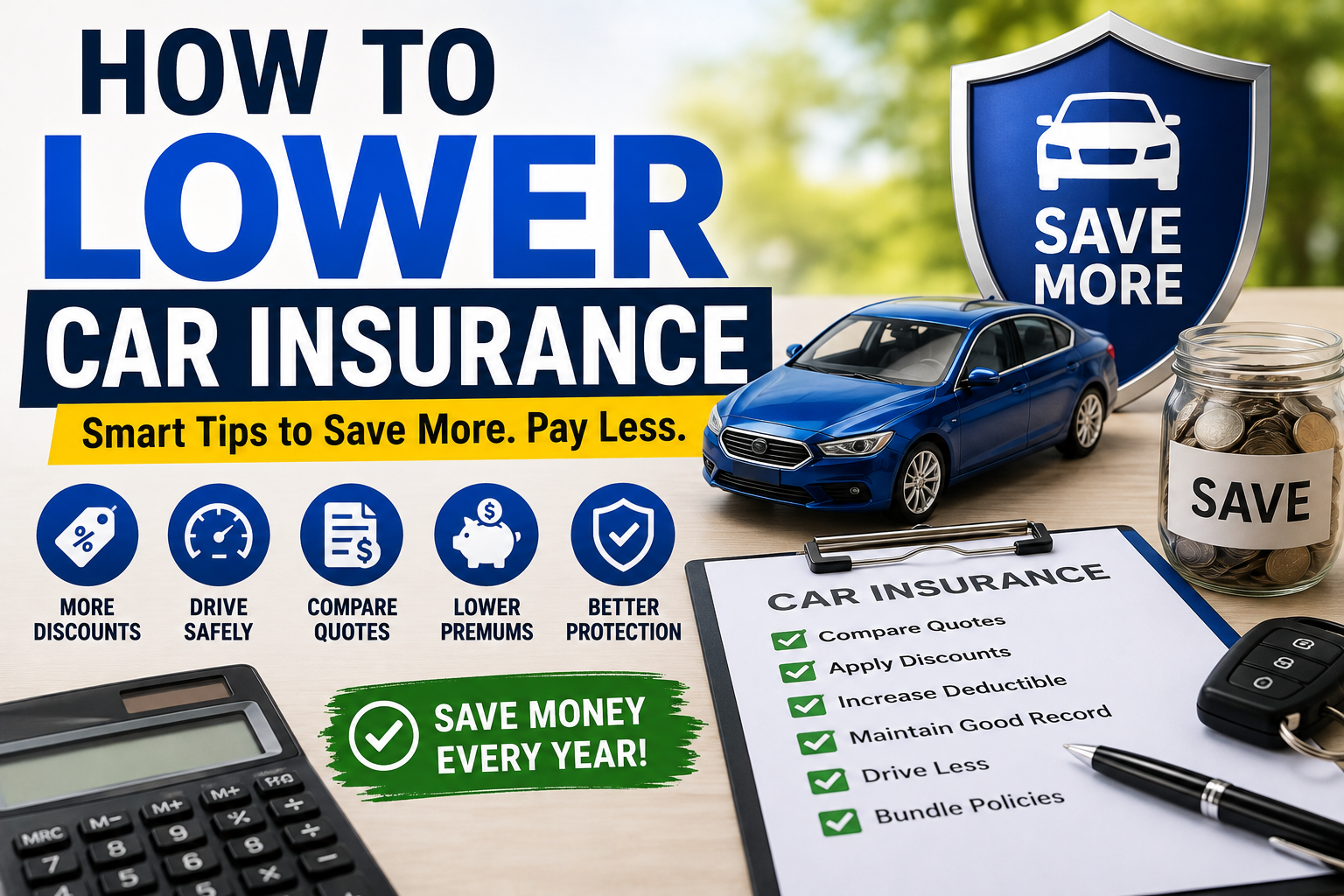
There are several legitimate ways to lower car insurance without simply dropping important protection. You can compare insurance quotes, ask about discounts, improve your driving record, adjust your deductible, review your coverage, reduce unnecessary mileage, and make sure your insurer has accurate information about your circumstances.
The key is knowing which changes can actually make a difference and which ones could leave you underinsured.
This guide explains how to lower car insurance from the simplest strategies to more advanced ways of reducing your auto insurance costs. It also explains what to consider before changing your coverage and how to balance a lower premium with appropriate financial protection.
Quick Answer: How Can You Lower Car Insurance?
The most effective ways to potentially reduce your car insurance premium include:
- Compare quotes from multiple insurers.
- Ask about every available discount.
- Maintain a clean driving record.
- Consider increasing your deductible if you can afford it.
- Review your coverage limits and optional coverage.
- Remove unnecessary coverage from an older vehicle when appropriate.
- Ask about low-mileage programs.
- Consider usage-based insurance if it suits your driving habits.
- Improve your credit-based insurance profile where legally permitted.
- Bundle eligible insurance policies.
- Keep your policy information accurate and up to date.
- Choose a vehicle with lower insurance costs.
- Avoid unnecessary claims when paying for a small repair yourself makes financial sense.
- Review your policy after major life changes.
- Re-shop your insurance periodically rather than automatically renewing.
Not every strategy will work for every driver. Insurance pricing depends on factors such as location, driving history, vehicle, coverage limits, claims history, mileage, and the insurer’s pricing model.
Why Is Car Insurance So Expensive?
Before trying to lower your premium, it helps to understand why insurance costs what it does.
Insurance companies generally consider the likelihood and potential cost of future claims when determining premiums.
Factors that can influence your rate include:
- Driving history
- Age
- Location
- Vehicle make and model
- Vehicle repair costs
- Annual mileage
- Claims history
- Coverage limits
- Deductibles
- Insurance history
- Credit-based insurance factors where permitted
- Household drivers
- Discounts
- Local accident and theft patterns
This means your insurance premium is not based solely on whether you personally have been in an accident.
For example, a driver with a perfect driving record may still pay more after moving to an area where accidents, vehicle theft, or repair costs are higher.
1. Shop Around and Compare Car Insurance Quotes
One of the most effective ways to potentially lower your car insurance is simply to compare prices from different insurers.
Insurance companies use different underwriting and pricing models. The same driver and vehicle can receive different quotes from different companies.
Why Comparing Quotes Matters
Suppose you currently pay:
$190 per month
Another insurer offers comparable coverage for:
$145 per month
The difference is:
$45 per month
Over a year, that would be:
$540
That is why comparing quotes can be more valuable than spending hours looking for tiny discounts.
Compare Equivalent Coverage
Do not compare a basic policy from one insurer against a broader policy from another.
When requesting quotes, try to keep the following consistent:
- Liability limits
- Collision coverage
- Comprehensive coverage
- Deductibles
- Uninsured motorist coverage
- Optional coverage
Otherwise, the cheapest quote may simply provide less protection.
2. Ask About Car Insurance Discounts
Many drivers qualify for discounts without realizing it.
Discounts vary by insurer, state, and individual circumstances, but common categories may include:
- Safe driver discounts
- Good student discounts
- Multi-policy discounts
- Multi-vehicle discounts
- Defensive driving discounts
- Low-mileage discounts
- Vehicle safety discounts
- Anti-theft discounts
- Automatic payment discounts
- Paid-in-full discounts
- Customer loyalty discounts
- Telematics or usage-based discounts
You should not assume a discount has automatically been applied.
Ask the insurer to review your policy and identify all discounts for which you may qualify.
3. Maintain a Clean Driving Record
Your driving history can have a major impact on your insurance costs.
Traffic violations and at-fault accidents can increase premiums because insurers may view them as indicators of higher future risk.
Examples include:
- Speeding tickets
- Reckless driving violations
- At-fault accidents
- Certain serious traffic offenses
- Driving-related convictions
The best way to protect your insurance premium is to develop safe driving habits.
Practical Safe-Driving Habits
- Avoid speeding.
- Leave adequate following distance.
- Avoid distracted driving.
- Never drive while impaired.
- Follow traffic signals.
- Use defensive driving techniques.
- Avoid aggressive lane changes.
- Keep your vehicle maintained.
A clean driving record can potentially help you qualify for better rates and safe-driver discounts over time.
4. Increase Your Deductible
Your deductible is the amount you generally agree to pay toward a covered claim before your insurer pays the remaining covered amount, subject to the policy.
For example, imagine your collision coverage has a:
$500 deductible
You might instead choose:
$1,000 deductible
A higher deductible can sometimes result in a lower premium.
However, there is an important trade-off.
Lower Deductible
Advantages:
- Less money required after a covered claim
- Easier to manage an unexpected repair bill
Disadvantages:
- Usually higher premium
Higher Deductible
Advantages:
- Potentially lower premium
- You retain more of the risk yourself
Disadvantages:
- You need more money available after a covered claim
Never choose a deductible so high that you would struggle to pay it after an accident.
5. Review Your Coverage
One of the most important steps in lowering auto insurance costs is reviewing exactly what you are paying for.
You may have coverage that made sense several years ago but no longer provides enough value for your current situation.
Review:
- Liability limits
- Collision coverage
- Comprehensive coverage
- Rental reimbursement
- Roadside assistance
- Gap coverage
- Medical payments
- Uninsured motorist coverage
- Underinsured motorist coverage
- Other optional protections
This does not mean you should remove important protection simply to get a cheaper premium.
Instead, understand what each coverage does and decide whether it still makes sense for you.
6. Consider Dropping Collision or Comprehensive Coverage on an Older Car
If you drive an older vehicle with a relatively low market value, you may want to evaluate whether collision and comprehensive coverage are still financially worthwhile.
Suppose your vehicle is worth approximately:
$3,000
Your annual premium for physical damage coverage may be substantial relative to the vehicle’s value.
In this situation, you could compare:
- Annual premium
- Deductible
- Vehicle value
- Likelihood of a claim
- Your ability to replace the vehicle
However, removing coverage means accepting additional risk.
If you finance or lease your vehicle, your lender or leasing company may require collision and comprehensive coverage.
7. Reduce Your Annual Mileage
Some insurers consider annual mileage when calculating premiums.
If you drive significantly less than you used to, tell your insurer.
For example, perhaps you previously drove:
15,000 miles per year
but now work remotely and drive:
6,000 miles per year
Your insurance company may offer a low-mileage program or adjust your pricing depending on its underwriting rules.
Who May Benefit?
Low-mileage pricing can potentially help:
- Remote workers
- Retirees
- Students
- People who use public transportation
- Drivers who carpool
- People who work close to home
Always provide accurate mileage information rather than intentionally underreporting how much you drive.
8. Consider Usage-Based Insurance
Some insurers offer telematics or usage-based insurance programs.
These programs may monitor driving behavior through a mobile app or dedicated device.
Depending on the program, factors can include:
- Speed
- Braking
- Acceleration
- Mileage
- Time of day
- Driving patterns
Drivers with safe habits may potentially receive discounts.
However, usage-based insurance is not automatically better for everyone.
Before enrolling, understand:
- What information is collected
- How it is used
- Whether participation is optional
- How the program affects your premium
- Whether poor driving behavior could increase costs
If you are already a cautious driver, this type of program may be worth investigating.
9. Bundle Your Insurance Policies
If you have multiple insurance policies, ask whether combining them with the same insurer could reduce your overall cost.
For example, you might have:
- Auto insurance
- Homeowners insurance
- Renters insurance
Some insurers offer multi-policy discounts when eligible policies are combined.
Example
Suppose you currently have:
Auto insurance: $1,800/year
Renters insurance: $240/year
Total:
$2,040/year
A bundled option could potentially reduce the combined cost, depending on the insurer and available discounts.
However, do not assume bundling is automatically cheaper.
Compare the total cost against buying each policy separately.
10. Ask About Multi-Car Discounts
If multiple vehicles are insured in your household, ask about a multi-vehicle discount.
For example, a household may have:
- One family sedan
- One SUV
- One vehicle driven by a college student
Insuring eligible vehicles with the same company may result in a discount.
Again, the exact savings depend on the insurer and policy structure.
11. Improve Your Credit-Based Insurance Profile Where Permitted
In some U.S. states, insurers may use credit-based insurance information as one factor in determining premiums, subject to applicable laws.
If this factor is permitted where you live, improving your financial profile may potentially help over time.
General financial habits include:
- Paying bills on time
- Reducing outstanding debt
- Avoiding unnecessary credit applications
- Checking credit reports for errors
- Managing credit responsibly
This is different from saying that good credit automatically guarantees cheap car insurance.
Insurance regulations differ by state, and some jurisdictions restrict or prohibit certain uses of credit information for auto insurance pricing.
12. Choose a Vehicle That Costs Less to Insure
Your vehicle itself can significantly affect insurance costs.
Two vehicles with similar purchase prices can have very different insurance premiums.
Factors can include:
- Repair costs
- Theft rates
- Safety features
- Vehicle value
- Accident claim history
- Performance
- Replacement parts
- Crash statistics
Before Buying a Vehicle
Do not only ask:
“Can I afford the car payment?”
Also ask:
“Can I afford the insurance?”
Request insurance estimates before purchasing the vehicle.
This can prevent an unpleasant surprise after the purchase.
13. Look for Safety and Anti-Theft Discounts
Vehicle safety features may help reduce risk.
Depending on the insurer, eligible features can include:
- Anti-lock brakes
- Airbags
- Anti-theft systems
- Electronic stability control
- Certain advanced driver-assistance technologies
Do not assume every feature automatically produces a discount.
Ask your insurer which features qualify under its discount program.
14. Take an Approved Defensive Driving Course
Some insurers offer discounts for completing an approved defensive driving course.
Eligibility can depend on:
- State
- Age
- Insurer
- Course provider
- Driver history
Before paying for a course, ask the insurance company whether it recognizes the specific program and whether completing it will actually reduce your premium.
This avoids spending money on a course that provides no insurance benefit.
15. Pay Your Premium in a Way That Saves Money
Some insurers may offer discounts or lower administrative costs for certain payment methods.
Possible options can include:
- Paying the full policy term upfront
- Automatic payments
- Electronic billing
- Paperless billing
However, never choose a payment method that creates financial stress simply to obtain a small discount.
Compare the total annual cost rather than focusing only on the monthly payment.
How to Lower Car Insurance After an Accident
If your premium increased after an accident, you still have options.
First: Review Your Policy
Understand:
- What caused the increase
- Whether the accident was classified as at-fault
- How long the surcharge may apply
- Whether accident forgiveness is available
Second: Shop Around
Do not assume every insurer will price your accident history identically.
Request new quotes while accurately disclosing your driving history.
Third: Improve Your Driving Record
Avoid additional violations.
Over time, older incidents may have less impact on pricing depending on the insurer’s rules and applicable regulations.
Fourth: Ask About Discounts
You may still qualify for:
- Bundling
- Low mileage
- Safety
- Defensive driving
- Other applicable discounts
How to Lower Car Insurance After a Speeding Ticket
A speeding ticket can increase insurance costs, but the impact varies.
The best approach is to:
- Maintain a clean record going forward.
- Ask whether an approved defensive driving course could help.
- Compare quotes from multiple insurers.
- Review available discounts.
- Avoid additional violations.
- Ask when the ticket may stop affecting your premium under the insurer’s rating rules.
Do not attempt to hide a ticket when requesting an insurance quote.
Insurance companies can verify driving records.
How to Lower Car Insurance for Young Drivers
Young drivers often face higher premiums because insurers generally consider inexperienced drivers to present greater risk.
There are several strategies worth exploring.
Good Student Discounts
Eligible students may qualify for discounts based on academic performance.
Driver Education
Some insurers offer discounts for qualifying driver education or training.
Safe Driving
A clean driving history becomes increasingly valuable as the driver gains experience.
Family Policy
In some situations, keeping a young driver on an eligible family policy may be less expensive than purchasing a separate policy.
Choose the Vehicle Carefully
A high-performance vehicle can be considerably more expensive to insure than a practical vehicle.
Before purchasing a car, obtain an insurance quote.
How to Lower Car Insurance for College Students
College students may have several opportunities to reduce auto insurance costs.
For example:
- Ask about good student discounts.
- Ask about distant-student discounts where applicable.
- Consider low-mileage programs.
- Compare insurers.
- Maintain a clean driving record.
- Review whether the student actually needs regular access to a vehicle.
If a student attends college far away and rarely drives the insured vehicle, the insurance situation may change.
Always tell the insurer about the student’s actual location and vehicle usage.
How to Lower Car Insurance for Seniors
Older drivers may have access to certain discounts depending on the insurer and state.
Potential strategies include:
- Ask about mature-driver discounts.
- Consider approved defensive driving programs.
- Compare insurers regularly.
- Review annual mileage.
- Reassess vehicle coverage.
- Maintain a clean driving record.
Insurance pricing can vary significantly, so comparing quotes remains important.
How to Lower Car Insurance Without Losing Coverage
This is an important distinction.
There are two basic approaches:
Approach A: Reduce Coverage
You pay less but accept more financial risk.
Approach B: Improve Pricing
You keep similar coverage but find a lower rate through:
- Discounts
- Comparison shopping
- Safe driving
- Lower mileage
- Bundling
- Telematics
- Better payment options
If your priority is maintaining protection, focus on Approach B first.
Should You Lower Your Liability Limits to Save Money?
This can reduce premiums in some circumstances, but it can also increase your financial risk.
Liability coverage generally pays for covered damages you cause to others, up to the applicable limits.
Imagine your policy has:
$50,000 bodily injury liability per person
A serious accident produces covered damages significantly above that amount.
The insurer’s obligation is generally limited by the policy terms and limits.
Lowering your limits can therefore leave you with greater potential financial exposure.
Before reducing liability limits, consider:
- Income
- Savings
- Assets
- Home ownership
- Vehicle use
- Driving frequency
- Personal risk tolerance
Saving a relatively small amount each month may not be worth dramatically increasing your potential exposure.
Should You Raise Your Deductible to Lower Insurance?
Potentially, yes.
This can be one of the cleaner ways to reduce premiums without reducing your liability limits.
However, calculate the trade-off.
Suppose:
$500 deductible: $180/month
$1,000 deductible: $160/month
Monthly savings:
$20
Annual savings:
$240
You are accepting an additional potential $500 of out-of-pocket cost in exchange for $240 in annual premium savings.
Whether that makes sense depends on your finances and how long you expect to keep the policy.
How to Decide if a Higher Deductible Is Worth It
Ask yourself:
Can I comfortably pay the higher deductible tomorrow?
If the answer is no, the lower deductible may be more appropriate.
You can also calculate your potential break-even point.
If increasing your deductible saves $240 per year and increases your potential out-of-pocket exposure by $500, it would take a little over two years of savings to equal that $500 difference.
This is a simplified calculation because actual claims, premiums, and policy changes can vary.
When Should You Re-Shop Your Car Insurance?
You do not necessarily need to change insurers every few months.
However, reviewing your options periodically can be useful.
Consider comparing rates when:
- Your policy renews
- Your premium increases significantly
- You move
- You buy a different vehicle
- You get married
- You add or remove a driver
- Your annual mileage changes
- Your driving record improves
- You become eligible for new discounts
- Your financial situation changes
Even if you do not switch, shopping around gives you information about the current market.
How to Compare Cheap Car Insurance Properly
When people search for cheap car insurance, they often focus only on price.
That can be a mistake.
Instead, compare the entire policy.
| Factor | Quote A | Quote B | Quote C |
|---|---|---|---|
| Monthly premium | $ | $ | $ |
| Annual premium | $ | $ | $ |
| Bodily injury limits | — | — | — |
| Property damage limit | — | — | — |
| Collision deductible | — | — | — |
| Comprehensive deductible | — | — | — |
| Uninsured motorist | — | — | — |
| Rental coverage | — | — | — |
| Roadside assistance | — | — | — |
A quote that is $15 cheaper per month may not actually be the better deal if it comes with substantially lower coverage or higher out-of-pocket costs.
What Not to Do When Trying to Lower Car Insurance
Saving money is important, but some strategies can create bigger problems.
Do Not Lie About Your Address
Your location can affect insurance pricing.
Using an inaccurate address to obtain a lower premium can create serious problems.
Do Not Underreport Mileage
If you drive 15,000 miles annually, do not claim that you drive 5,000 simply to get a lower rate.
Provide accurate information.
Do Not Hide Household Drivers
If another person regularly drives your vehicle, disclose the information required by your insurer.
Do Not Buy Coverage You Cannot Understand
A very cheap policy is not necessarily a good policy if you do not understand its exclusions and limits.
Do Not Choose an Unaffordable Deductible
A lower monthly premium is not helpful if you cannot afford the deductible after an accident.
Common Myths About Lowering Car Insurance
Myth 1: The Cheapest Insurer Is Always the Best
Not necessarily.
Insurance pricing and coverage differ between companies.
Myth 2: Switching Insurers Always Saves Money
Sometimes it does. Sometimes your current insurer is already competitive.
Compare before switching.
Myth 3: Removing All Optional Coverage Is the Best Way to Save
It can reduce the premium, but it also increases your financial risk.
Myth 4: A New Car Always Costs More to Insure
Not necessarily.
Insurance depends on numerous characteristics beyond purchase price.
Myth 5: Everyone Gets the Same Discount
Discount eligibility varies by insurer, state, and driver.
Myth 6: Minimum Coverage Is Always Enough
Minimum coverage can satisfy legal requirements but may not provide adequate financial protection for every driver.
A Practical Example: Reducing a $2,400 Annual Premium
Imagine John currently pays:
$2,400 per year
for his car insurance.
Instead of immediately cutting liability coverage, he reviews his policy.
He discovers:
- He qualifies for a safe-driver discount.
- His annual mileage has fallen.
- He can receive a multi-policy discount.
- A different insurer offers comparable coverage for less.
- He is comfortable increasing his collision deductible from $500 to $1,000.
After comparing the options, suppose he finds a policy costing:
$1,750 per year
Potential annual savings:
$650
The important point is not the exact dollar amount.
The lesson is that several small changes can sometimes combine into meaningful savings without dramatically reducing protection.
Advanced Strategy: Calculate Your Total Insurance Cost
Do not look only at your monthly premium.
Calculate:
Annual premium + expected out-of-pocket costs + deductible exposure
For example, a policy with a lower premium but a very high deductible might look attractive initially.
Suppose:
Policy A
Annual premium: $1,500
Deductible: $2,000
Policy B
Annual premium: $1,750
Deductible: $500
Policy A is $250 cheaper per year, but Policy B exposes you to substantially less out-of-pocket cost for a covered claim.
Neither policy is automatically better.
The right choice depends on your financial situation and risk tolerance.
How to Lower Car Insurance in the Long Term
The best savings strategy is not always a one-time discount.
Build habits that reduce your insurance costs over time.
Year 1
Focus on:
- Clean driving
- Comparing quotes
- Discounts
- Accurate information
Year 2
Review:
- Mileage
- Coverage
- Deductibles
- Vehicle value
Year 3
Compare:
- New insurer rates
- Available discounts
- Changing coverage needs
Long Term
Continue maintaining:
- Good driving habits
- Responsible financial habits where relevant
- Appropriate coverage
- Accurate policy information
Insurance is an ongoing expense, so periodic reviews can prevent you from automatically paying more than necessary.
Frequently Asked Questions
What is the fastest way to lower car insurance?
Comparing quotes and checking for discounts are among the fastest strategies to investigate. You can also ask your insurer whether your mileage, payment method, vehicle information, or coverage selections have changed.
How can I lower my car insurance without switching companies?
Ask about discounts, review your mileage, consider an appropriate deductible, remove unnecessary optional coverage, explore usage-based insurance, and ask whether bundling policies could reduce your premium.
Does increasing my deductible lower car insurance?
It can. A higher deductible may reduce the premium because you agree to take on more of the cost of a covered claim. Only choose a deductible you could comfortably afford.
How can I lower car insurance after an accident?
Compare quotes, maintain a clean driving record afterward, ask about available discounts, review your coverage, and determine whether accident-related surcharges are still affecting your rate.
How can I lower car insurance after a speeding ticket?
Maintain a clean driving record, compare insurers, ask whether an approved defensive driving course could help, and check for available discounts. The effect of a ticket varies by insurer and state.
Does good credit lower car insurance?
In some states, insurers may use credit-based insurance information as a rating factor. Where permitted, responsible credit management may potentially help. Laws vary significantly by state.
Can I lower car insurance by driving less?
Potentially. Some insurers offer low-mileage programs or pricing based partly on annual mileage. Provide accurate information about how much you actually drive.
Is usage-based insurance worth it?
It can be worthwhile for drivers who consistently demonstrate safe driving behavior and qualify for favorable pricing. However, understand how the program collects and uses driving data and whether participation could affect your premium.
Does bundling home and auto insurance save money?
It can. Some insurers offer multi-policy discounts. However, compare the combined price against separate policies because bundling is not automatically the cheapest option.
Can I lower car insurance by dropping full coverage?
Potentially, especially on an older vehicle with low value. However, removing collision or comprehensive coverage means accepting more financial risk. If your vehicle is financed or leased, your lender may require those coverages.
How often should I compare car insurance rates?
A yearly review is reasonable for many drivers, particularly around renewal. You should also compare rates after major changes such as moving, buying a vehicle, adding a driver, or experiencing a significant premium increase.
What makes car insurance expensive?
Factors can include location, age, driving history, claims history, vehicle type, annual mileage, coverage limits, deductibles, insurance history, and other rating factors permitted in your state.
Does a newer car always cost more to insure?
No. Insurance premiums depend on many factors, including repair costs, safety characteristics, theft risk, vehicle value, claims history, and insurer pricing.
Should I lower my liability limits to save money?
You can ask your insurer how different limits affect your premium, but lowering liability limits increases your potential financial exposure after an at-fault accident. Consider your assets, income, and financial situation before making this change.
Can defensive driving lower my insurance?
Some insurers offer discounts for approved defensive driving courses. Eligibility varies, so check with your insurer before paying for a course.
How much can I save by lowering my car insurance?
There is no universal amount. Savings depend on your current premium, insurer, location, vehicle, driving history, coverage, discounts, and available alternatives. Comparing quotes is the best way to determine your potential savings.
Final Thoughts: How to Lower Car Insurance Without Taking Unnecessary Risks
Learning how to lower car insurance is not simply about finding the cheapest possible policy.
The goal is to reduce unnecessary costs while maintaining a level of protection that makes sense for your financial situation.
Start with the strategies that do not require sacrificing coverage.
Compare quotes.
Ask about discounts.
Maintain a clean driving record.
Check your mileage.
Review your policy.
Consider bundling.
Investigate usage-based programs.
Then evaluate more significant changes, such as increasing your deductible or removing physical-damage coverage from an older vehicle.
Be careful when reducing liability limits or eliminating important protection simply to save a few dollars each month. A lower premium can sometimes create substantially greater financial risk after a serious accident.
The smartest insurance strategy is therefore not:
“How do I get the cheapest policy?”
It is:
“How do I get the best value for the level of protection I actually need?”
Actionable Takeaways
Before your next policy renewal, take these steps:
- Get several car insurance quotes.
- Compare identical coverage levels.
- Ask your insurer to review every available discount.
- Check whether your annual mileage has changed.
- Review your deductibles.
- Consider whether optional coverage still makes sense for your vehicle.
- Ask about usage-based insurance if you are a safe driver.
- Maintain a clean driving record.
- Check whether bundling policies could reduce your total cost.
- Get an insurance estimate before buying your next vehicle.
- Never provide false information to obtain a cheaper premium.
- Review your insurance at least once a year.
A few minutes spent reviewing your policy can reveal savings opportunities that you may otherwise miss. The best result is not simply a lower monthly bill—it is lower insurance costs without creating unnecessary financial exposure.