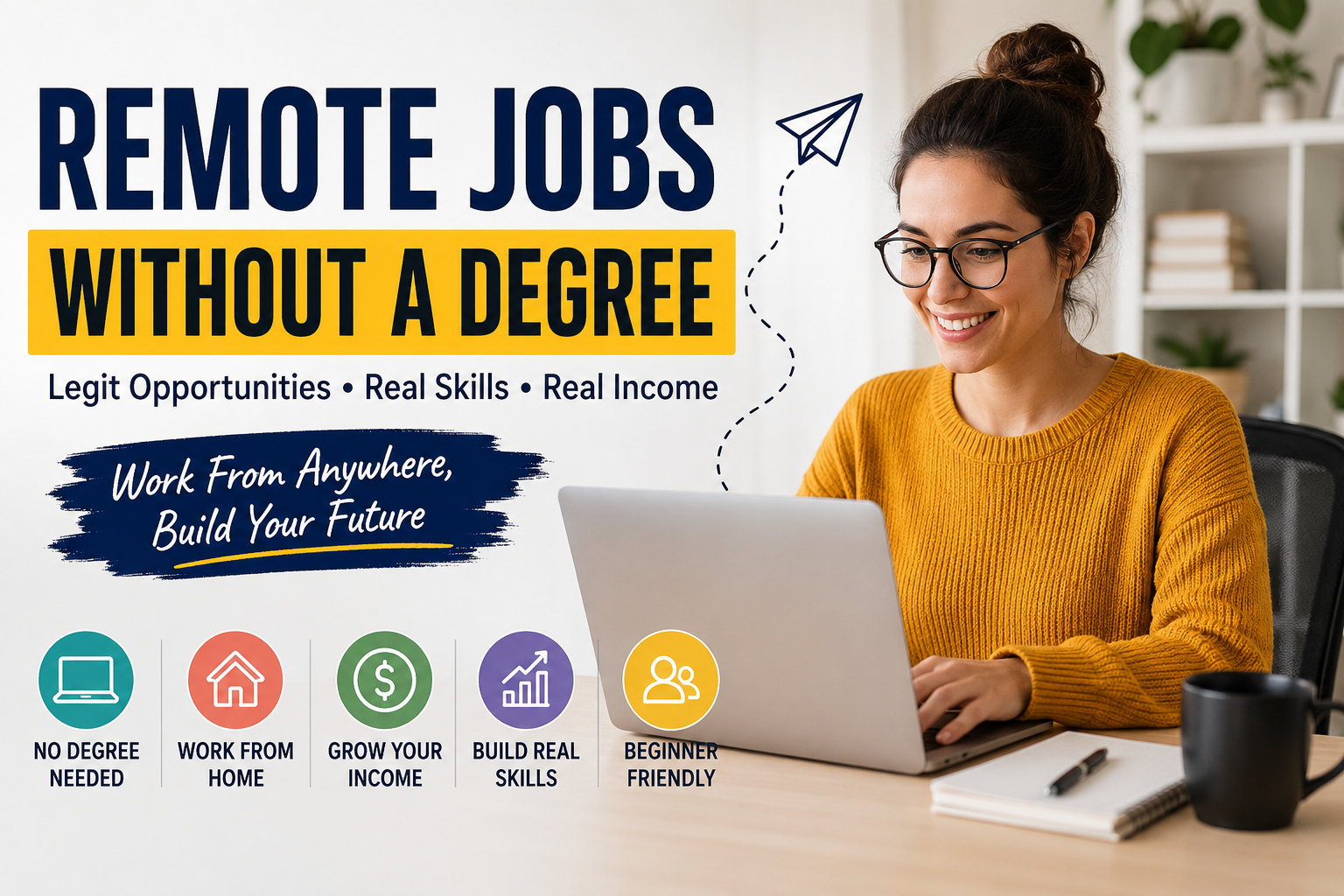
Discover the best remote jobs without a degree, where to find them, skills to learn, expected pay, and how to avoid remote job scams.
Working remotely has changed the way millions of people think about employment. A traditional office, long commute, and four-year college degree are no longer the only routes to building a career.
If you do not have a university degree, that does not mean you cannot earn money online or build a successful remote career. Many employers care more about practical skills, communication, reliability, previous results, and the ability to complete work independently than they do about formal education.
There are now remote opportunities in customer service, virtual assistance, sales, digital marketing, writing, design, bookkeeping, technical support, data entry, social media management, and many other fields.
The important part is knowing which jobs are realistic, which skills employers actually want, where to find legitimate opportunities, and how to compete with applicants who have more experience.
This guide explains how to find remote jobs without a degree, what you can expect to earn, which careers are easiest to enter, what skills you should develop, and how to avoid common work-from-home scams.
What Are Remote Jobs Without a Degree?
Remote jobs without a degree are employment opportunities that can be performed from home or another location without requiring a university or college degree as a mandatory qualification.
Instead of focusing primarily on formal education, these jobs may evaluate candidates based on:
- Practical skills
- Work experience
- Communication
- Computer proficiency
- Portfolio projects
- Certifications
- Problem-solving ability
- Customer service skills
- Sales performance
- Reliability
- Ability to work independently
Some remote positions may say a degree is “preferred” rather than required. In those situations, relevant experience and demonstrated skills can sometimes compensate for the lack of formal education.
Does Every Remote Job Require a Degree?
No.
Some professions, particularly regulated or highly specialized careers, commonly require formal qualifications. However, many entry-level and skill-based remote positions do not necessarily require a degree.
For example, a company may be more interested in whether a customer support representative can communicate clearly and solve customer problems than whether that person has a university diploma.
Similarly, a business hiring a social media assistant may care more about content creation skills, platform knowledge, and previous results than academic credentials.
The key is to target jobs where skills and demonstrated ability are more important than formal education.
Why Are Remote Jobs Becoming So Popular?
Remote work offers several advantages for both workers and employers.
For workers, one of the biggest benefits is flexibility. Instead of spending hours commuting to an office, employees can often work from their homes.
Remote employment can also provide access to companies outside your local area. Someone living in a smaller city may be able to apply for opportunities with companies located in major business centers.
Major Benefits of Remote Work
1. No daily commute
You can potentially eliminate transportation costs and save time.
2. More location flexibility
Some jobs allow employees to work from different locations, although this depends on the employer’s rules and tax requirements.
3. Access to international companies
Remote positions can allow qualified workers to apply for companies outside their immediate geographic area.
4. Lower work-related expenses
Working from home can reduce spending on transportation, meals outside the home, and office clothing.
5. Flexible opportunities
Some remote work is full-time, while other opportunities are part-time, freelance, contract, or project-based.
6. Skill-based career growth
A person can start with an entry-level position and gradually move into higher-paying specialist roles.
20 Best Remote Jobs Without a Degree
The best remote job for you depends on your existing abilities, interests, English proficiency, technical knowledge, and willingness to learn.
Here are some of the most accessible options.
| Remote Job | Beginner Friendly | Degree Usually Required? | Important Skills |
|---|---|---|---|
| Customer Support Representative | Yes | No | Communication, problem-solving |
| Virtual Assistant | Yes | No | Organization, communication |
| Data Entry Specialist | Yes | No | Accuracy, typing |
| Social Media Assistant | Yes | No | Social media, content |
| Content Writer | Yes | No | Writing, research |
| Sales Representative | Yes | No | Communication, persuasion |
| Appointment Setter | Yes | No | Communication, organization |
| Transcriptionist | Yes | No | Listening, typing |
| Bookkeeping Assistant | Moderate | Not always | Accounting software, accuracy |
| Graphic Designer | Moderate | No | Design software |
| Video Editor | Moderate | No | Editing software |
| SEO Assistant | Moderate | No | SEO, research |
| Digital Marketing Assistant | Moderate | No | Marketing tools |
| Web Designer | Moderate | No | HTML, CSS, design |
| WordPress Specialist | Moderate | No | WordPress, basic web skills |
| Technical Support Specialist | Moderate | No | Troubleshooting |
| Email Marketing Assistant | Moderate | No | Copywriting, marketing |
| Recruiter/Sourcing Assistant | Moderate | No | Communication, research |
| E-commerce Assistant | Moderate | No | Product management, platforms |
| Freelance Specialist | Depends | No | Specialized skill |
Let’s examine these opportunities in more detail.
1. Customer Support Representative
Customer service is one of the most common entry-level remote career paths.
Companies need representatives to answer customer questions, resolve problems, process requests, and communicate through email, chat, or telephone.
Typical responsibilities
- Answer customer questions
- Respond to emails
- Handle live chat
- Process customer requests
- Troubleshoot basic issues
- Escalate complex problems
- Update customer records
Skills needed
You generally need:
- Clear communication
- Patience
- Basic computer skills
- Good typing ability
- Problem-solving
- Professional writing
For international companies, English proficiency can be particularly valuable.
2. Virtual Assistant
A virtual assistant provides administrative support remotely.
This is particularly attractive for beginners because many tasks can be learned relatively quickly.
Common virtual assistant tasks
- Managing calendars
- Responding to emails
- Researching information
- Creating documents
- Updating spreadsheets
- Scheduling appointments
- Organizing files
- Managing basic social media tasks
- Entering information into systems
A virtual assistant can eventually specialize in areas such as executive assistance, real estate assistance, e-commerce assistance, or social media management.
3. Data Entry
Data entry is frequently advertised as a beginner-friendly remote job.
The work can involve transferring information between systems, updating databases, entering spreadsheet information, or organizing digital records.
However, applicants should be careful because fake data-entry jobs are also commonly used in online scams.
A legitimate employer should not demand large upfront payments simply to give you access to work.
Useful skills
- Fast and accurate typing
- Attention to detail
- Spreadsheet knowledge
- Basic computer skills
- Organization
4. Social Media Assistant
Businesses need people who can help manage their social media presence.
A social media assistant may create posts, schedule content, respond to comments, research trends, and monitor engagement.
You do not necessarily need a degree.
Instead, you can demonstrate your ability by creating sample social media posts or managing a small personal project.
Skills worth learning
- TikTok
- Canva
- Basic copywriting
- Content planning
- Social media analytics
A strong portfolio can make a significant difference.
5. Content Writer
If you are good at writing and research, content writing can become a remote career.
Writers create:
- Blog articles
- Website pages
- Product descriptions
- Email content
- Social media posts
- Guides
- Scripts
- Marketing copy
A degree in English or journalism is not always necessary.
Clients primarily want writing that is clear, accurate, engaging, and useful to readers.
How beginners can build experience
Create several sample articles covering different subjects.
For example:
- A 1,500-word informational article
- A product comparison
- A beginner’s guide
- An SEO article
- A short marketing landing page
These samples can become your portfolio.
6. Sales Representative
Sales is another field where performance can matter more than academic credentials.
Remote sales professionals may communicate with potential customers through phone calls, email, video meetings, or messaging platforms.
Possible positions include:
- Sales development representative
- Inside sales representative
- Business development representative
- Appointment setter
- Lead generation specialist
People who become good at sales can potentially progress into higher-paying positions because their work directly contributes to company revenue.
7. Appointment Setter
Appointment setters contact potential customers and schedule meetings for sales teams.
For example, a company selling business software might employ appointment setters to contact qualified prospects and arrange calls with sales representatives.
You need:
- Good communication
- Confidence
- Organization
- Persistence
- Basic CRM knowledge
This can be a useful entry point into the broader sales industry.
8. Transcriptionist
Transcription involves converting audio or video into written text.
The work may include:
- Interviews
- Meetings
- Podcasts
- Educational recordings
- Business discussions
Important skills include accurate listening, fast typing, grammar, and attention to detail.
Artificial intelligence has changed the transcription industry considerably, so beginners should consider developing complementary skills such as editing, proofreading, timestamping, and specialized transcription.
9. Bookkeeping Assistant
Bookkeeping is another potential remote career for people without a traditional degree.
However, this field requires more specialized knowledge than basic data entry.
You may need to understand:
- Invoices
- Expenses
- Bank reconciliation
- Accounts payable
- Accounts receivable
- Accounting software
- Basic financial terminology
A short bookkeeping course or practical certification can make your application stronger.
10. Graphic Designer
Graphic design is fundamentally a portfolio-driven profession.
Clients usually care about what you can create.
You can start by learning tools such as:
- Canva
- Adobe Photoshop
- Adobe Illustrator
- Figma
Beginner designers can create sample:
- Social media graphics
- YouTube thumbnails
- Logos
- Advertisements
- Presentation slides
- Website graphics
A portfolio containing strong examples can be more persuasive than simply claiming that you know graphic design.
11. Video Editor
Video editing is increasingly useful for businesses, creators, agencies, and online educators.
You can learn editing using software such as:
- CapCut
- Adobe Premiere Pro
- DaVinci Resolve
- Final Cut Pro
Beginners can create sample projects rather than waiting for a client to give them experience.
For example, create:
- A short-form social media video
- A YouTube video
- A promotional advertisement
- A talking-head edit
- A product video
Then organize those samples into a simple portfolio.
12. SEO Assistant
Search engine optimization is a strong option for people interested in websites and digital marketing.
An SEO assistant may help with:
- Keyword research
- Content optimization
- Title and meta description optimization
- Internal linking
- Competitor research
- Basic technical SEO
- Search performance analysis
You do not necessarily need a university degree to begin.
However, SEO requires continuous learning because search engines, websites, and digital marketing practices change.
13. Digital Marketing Assistant
Digital marketing includes several disciplines.
A beginner might help with:
- Social media
- SEO
- Email marketing
- Content marketing
- Advertising
- Analytics
- Lead generation
This career has a strong advantage: you can build practical experience through your own projects.
For example, you can create a website, grow a social media account, or run a small content project and use the results as evidence of your skills.
14. WordPress Specialist
WordPress powers a large portion of websites, creating opportunities for people who understand how to build and manage websites.
A WordPress specialist might:
- Build websites
- Install themes
- Configure plugins
- Upload content
- Fix basic website issues
- Optimize pages
- Manage websites
- Perform basic SEO
You can begin without becoming a professional programmer.
Learning WordPress, HTML, CSS, basic JavaScript, and SEO can eventually allow you to offer more advanced services.
15. E-commerce Assistant
Online stores require people to handle day-to-day operations.
An e-commerce assistant may:
- Add products
- Update product descriptions
- Manage inventory information
- Process orders
- Answer customer questions
- Upload images
- Research products
- Manage product categories
Knowledge of platforms such as Shopify, WooCommerce, or other e-commerce systems can increase your opportunities.
16. Technical Support Specialist
Technical support can be a good career for people who enjoy troubleshooting.
Depending on the company, you may help customers with:
- Account problems
- Software installation
- Password issues
- Basic configuration
- Device troubleshooting
- Technical questions
A degree is not necessarily required for every support position.
Industry certifications and hands-on troubleshooting experience can help you stand out.
17. Email Marketing Assistant
Businesses use email to communicate with customers, generate sales, and retain existing users.
An email marketing assistant may help create:
- Promotional emails
- Newsletters
- Automated sequences
- Customer onboarding emails
- Product announcements
Useful skills include copywriting, segmentation, analytics, and knowledge of email marketing platforms.
18. Recruiter or Recruiting Assistant
Recruiting involves finding and communicating with potential employees.
Remote recruiting roles may involve:
- Searching for candidates
- Reviewing resumes
- Scheduling interviews
- Contacting applicants
- Updating applicant tracking systems
- Coordinating with hiring managers
Communication and research skills are particularly important.
19. Web Designer
Web design can become a strong remote career without a university degree.
A beginner can start with visual website builders and gradually learn:
- HTML
- CSS
- Responsive design
- UX principles
- Figma
- WordPress
As your skills improve, you can move from simple websites to more sophisticated projects.
20. Freelance Specialist
Freelancing is different from traditional employment.
Instead of working for one employer, you provide services to clients.
Potential freelance services include:
- Writing
- SEO
- Graphic design
- Video editing
- Web design
- Virtual assistance
- Social media management
- E-commerce management
- Translation
- Data analysis
The biggest advantage is flexibility.
The biggest challenge is that you are responsible for finding clients and maintaining consistent income.
How to Get a Remote Job Without a Degree
Getting a remote job without a degree is easier when you stop trying to compete on education and start competing on evidence of ability.
Use this process.
Step 1: Choose One Career Path
Do not try to learn ten skills simultaneously.
Choose one realistic field based on your interests and strengths.
For example:
Good with communication?
Consider customer support or sales.
Good at writing?
Consider content writing or copywriting.
Creative?
Consider graphic design or video editing.
Interested in websites?
Consider WordPress, web design, or SEO.
Organized?
Consider virtual assistance or project coordination.
Step 2: Learn the Essential Skills
You do not need to know everything.
Focus on the skills employers actually expect from entry-level workers.
For example, a beginner SEO assistant might need:
- Keyword research
- Search intent
- On-page SEO
- Basic technical SEO
- Content optimization
- Spreadsheet skills
Do not spend six months collecting random certificates without practicing.
Step 3: Build a Portfolio
This is one of the most important steps for people without degrees.
A portfolio answers the employer’s most important question:
“Can this person actually do the work?”
You can create portfolio projects even without clients.
Example: Beginner SEO portfolio
Create:
- A keyword research document
- Three optimized articles
- A competitor analysis
- An SEO audit
- A content plan
Example: Beginner graphic design portfolio
Create:
- Five social media designs
- Three thumbnails
- Two advertisements
- Two website banners
- One brand identity concept
Example: Beginner video editing portfolio
Create:
- Three short-form videos
- Two YouTube edits
- One promotional video
- One product advertisement
Your portfolio should demonstrate your skills rather than simply listing them.
Step 4: Create a Professional Resume
A degree should not dominate your resume if the job does not require one.
Instead, emphasize:
- Skills
- Projects
- Relevant experience
- Certifications
- Tools
- Achievements
- Portfolio
Example
Instead of writing:
“I have no professional experience.”
You can emphasize:
“Created and optimized 15 SEO-focused articles targeting informational search queries.”
The second statement demonstrates activity and ability.
Always be truthful, but present your practical work professionally.
Step 5: Optimize Your Online Profile
Your online professional profile should clearly communicate:
What you do + who you help + what skills you have.
For example:
SEO Content Writer | On-Page SEO | Keyword Research | Blog Content
is more informative than:
Looking for work.
Your profile should make it easy for a potential employer to understand your value.
Step 6: Apply Strategically
Sending hundreds of random applications is not necessarily the best strategy.
Instead:
- Find a relevant position.
- Read the requirements carefully.
- Identify your matching skills.
- Customize your resume.
- Highlight relevant projects.
- Submit a professional application.
- Track the application.
- Follow up when appropriate.
Quality applications are usually more useful than mass applications.
Skills That Can Help You Get Remote Work
If you do not have a degree, developing practical skills can significantly improve your chances.
Technical Skills
Depending on your career:
- Microsoft Excel
- Google Sheets
- WordPress
- Shopify
- Canva
- Figma
- Video editing
- SEO
- CRM software
- Basic HTML/CSS
- Analytics
- Project management software
Soft Skills
Remote employers also care about:
- Communication
- Time management
- Reliability
- Organization
- Problem-solving
- Self-discipline
- Attention to detail
- Collaboration
Remote workers often have more independence than office workers, so employers need people who can manage their responsibilities without constant supervision.
Can You Get a Remote Job With No Experience?
Yes, but you need to be realistic.
“No experience” does not mean you have to offer nothing.
You can create experience through projects.
For example, if you want a social media job, create a sample social media strategy for a fictional business.
If you want to become an SEO assistant, conduct an SEO audit of a website and create sample optimized content.
If you want to become a video editor, produce several sample videos.
This creates evidence that you understand the work.
Experience Can Come From Several Sources
Relevant experience may include:
- Personal projects
- Freelance projects
- Volunteer work
- Internships
- School projects
- Small business work
- Contract work
- Portfolio projects
The important thing is to describe your experience honestly.
Remote Jobs vs Freelancing
These two paths are often confused.
| Feature | Remote Job | Freelancing |
|---|---|---|
| Employer | Usually one company | Multiple clients |
| Income | Often more predictable | Can fluctuate |
| Schedule | Employer-defined | More flexible |
| Benefits | May be available | Usually self-managed |
| Client hunting | Usually unnecessary | Required |
| Long-term stability | Potentially higher | Depends on client base |
| Independence | Moderate | High |
A remote job can provide stability, while freelancing can provide greater flexibility and potentially allow you to build your own business.
Some people eventually combine both.
How Much Can You Earn Without a Degree?
There is no single salary for remote workers without degrees.
Income depends on:
- Job type
- Country
- Employer
- Experience
- Skill level
- English proficiency
- Industry
- Employment arrangement
- Portfolio
- Negotiation ability
Entry-level work generally pays less than specialized work.
For example, basic administrative work may have a lower earning ceiling than specialized software development, SEO consulting, or advanced sales.
The important strategy is to think beyond your first remote job.
Your first job can provide experience.
Your second role can provide specialization.
Your third role can provide higher income.
A Typical Career Progression
Stage 1: Learn a skill
↓
Stage 2: Build portfolio projects
↓
Stage 3: Get entry-level work
↓
Stage 4: Develop specialized expertise
↓
Stage 5: Move into higher-paying positions
↓
Stage 6: Become a specialist, consultant, manager, or independent freelancer
This approach is often more sustainable than trying to find a high-paying remote job immediately.
Best Remote Jobs for Beginners
If you are starting from zero, these fields can be worth considering:
Easiest to start
- Customer support
- Virtual assistance
- Data entry
- Appointment setting
- Basic social media assistance
- Transcription
Moderate learning curve
- Content writing
- SEO
- Bookkeeping
- Graphic design
- Video editing
- E-commerce assistance
Longer-term skill paths
- Web development
- Advanced SEO
- Digital marketing
- Data analytics
- Technical support
- UX/UI design
“Easiest” does not necessarily mean “best.”
A job with a low barrier to entry can also have intense competition and limited earning potential.
Remote Jobs for People With Strong English Skills
English proficiency can create additional opportunities because many international businesses require employees who can communicate with customers and colleagues in English.
Potential positions include:
- Customer support
- Content writing
- Virtual assistance
- Sales
- Appointment setting
- Recruiting
- Social media management
- Technical support
- Email support
If your English is not yet strong, improving written and spoken communication can increase your job options considerably.
Remote Jobs for People Who Are Good With Computers
If you already spend a lot of time using computers, consider developing a technical specialization.
Possible paths include:
- WordPress
- Web design
- SEO
- Technical support
- E-commerce management
- Video editing
- Graphic design
- Data analysis
- Software testing
Basic computer familiarity is useful, but specialized skills are what generally make you more valuable.
Remote Jobs You Can Do From Home With a Laptop
Many remote jobs require only:
- Laptop or desktop computer
- Reliable internet
- Headphones
- Quiet workspace
- Relevant software
- Professional communication
Depending on the position, you may also need a webcam or microphone.
Before accepting a job, check whether the employer provides equipment or expects you to supply it yourself.
How to Identify Legitimate Remote Jobs
Remote work scams are a serious problem.
Be especially cautious when an opportunity promises unusually high income for extremely simple work.
Warning Signs of a Remote Job Scam
1. You must pay to get hired
A legitimate employer generally does not require you to pay a large “registration fee” to receive a job.
2. Guaranteed huge earnings
Claims such as “make thousands every week with no experience” should be treated cautiously.
3. No proper interview
If someone offers you a job immediately without assessing your skills, investigate carefully.
4. Pressure to act immediately
Scammers may claim that you must pay or provide information urgently.
5. Requests for sensitive financial information
Be careful about providing banking or identity information before you have verified the employer and hiring process.
6. Poor communication
Unprofessional email addresses, suspicious websites, inconsistent job descriptions, and strange payment requests can all be warning signs.
7. Cryptocurrency or gift-card payment demands
Be extremely cautious if someone asks you to send money, cryptocurrency, gift cards, or other payments as part of the hiring process.
How to Protect Yourself From Remote Work Scams
Before accepting a remote position:
- Research the company.
- Verify the company’s website and contact information.
- Search for independent information about the employer.
- Check whether the job description is consistent.
- Confirm the interview process.
- Never send money simply to receive a job.
- Be careful with identity documents.
- Never install suspicious software at an employer’s request without verifying the company.
- Be cautious of unrealistic salary promises.
- Trust your judgment if something feels wrong.
Remember:
A remote job should pay you for your work—not require you to pay someone for the privilege of working.
How to Stand Out Without a Degree
Competition can be intense.
Your goal is not to convince employers that degrees are unimportant.
Your goal is to demonstrate that you can produce results.
Build Proof of Work
Instead of simply saying:
“I know SEO.”
Show:
- Keyword research
- Content optimization
- SEO audits
- Search intent analysis
- Sample articles
Instead of saying:
“I can edit videos.”
Show several polished videos.
Instead of saying:
“I am good at social media.”
Show an actual content calendar and sample posts.
Proof is powerful because it reduces uncertainty for the employer.
Certifications vs Experience
Certifications can help, but they are not magic.
A certificate shows that you completed training.
A portfolio shows that you can apply what you learned.
Ideally, combine both.
Weak profile
Certificate + no practical work
Stronger profile
Certificate + portfolio + practical project
Strongest beginner profile
Relevant training + strong portfolio + measurable project results + communication skills
If you have limited professional experience, projects become particularly important.
Should You Hide the Fact That You Don’t Have a Degree?
No.
Never lie about your education.
If a job specifically requires a degree, do not falsely claim that you have one.
Instead, target positions where the qualification is not mandatory and emphasize your relevant skills, portfolio, experience, and certifications.
Honesty also protects you from problems later if an employer verifies your background.
How to Build a Remote Career Without College
A successful remote career is usually built gradually.
Phase 1: Exploration
Spend a few days researching different career paths.
Ask:
- What skills do I already have?
- What work do I enjoy?
- How long will the skill take to learn?
- Are there entry-level opportunities?
- Can I build a portfolio?
Phase 2: Skill Development
Choose one skill and practice consistently.
Avoid jumping from one course to another.
Phase 3: Portfolio Building
Create realistic projects.
Treat them like client work.
Phase 4: Job Applications
Apply for entry-level positions that match your abilities.
Phase 5: Experience
Once you get your first opportunity, focus on reliability and quality.
Phase 6: Specialization
After gaining experience, specialize.
For example:
Digital marketing → SEO → Technical SEO
or
Design → Graphic design → Brand identity
or
E-commerce → Shopify → Shopify store optimization
Specialization can make it easier to differentiate yourself.
Common Mistakes Beginners Make
Mistake 1: Learning Too Many Skills
Trying to learn SEO, coding, design, video editing, marketing, and data analytics simultaneously can slow you down.
Choose one primary direction.
Mistake 2: Waiting Until You Feel “Ready”
You do not need to know everything before applying.
Learn the fundamentals, create proof of work, and continue improving.
Mistake 3: Applying Without a Portfolio
For skill-based positions, a portfolio can dramatically improve your credibility.
Mistake 4: Applying to Every Job
Target relevant positions instead.
Mistake 5: Believing Every “Work From Home” Advertisement
Some opportunities are legitimate. Others are scams.
Evaluate them carefully.
Mistake 6: Focusing Only on Salary
Your first position should also provide:
- Experience
- Skills
- References
- Portfolio material
- Industry knowledge
A strategic first job can be more valuable than a slightly higher-paying but stagnant opportunity.
A 30-Day Plan to Start Looking for Remote Work
If you are starting from zero, use a structured approach.
Days 1–3: Choose a Skill
Select one career path.
Days 4–10: Learn the Fundamentals
Focus on the core skills required for entry-level work.
Days 11–18: Create Portfolio Projects
Build three to five strong examples.
Days 19–21: Prepare Your Resume
Emphasize skills, projects, tools, and relevant experience.
Days 22–24: Build Your Professional Profile
Clearly explain what you do and what services or skills you offer.
Days 25–30: Start Applying
Apply consistently to relevant positions and improve your application based on feedback.
The process should continue beyond 30 days. The goal is to establish a repeatable system rather than expect immediate employment.
What If You Live Outside the United States?
You can still pursue remote work, but location restrictions matter.
Some companies hire internationally, while others only hire employees who live in specific countries or regions.
Before applying, check:
- Location requirements
- Time-zone requirements
- Work authorization
- Payment method
- Employment classification
- Tax obligations
- Required working hours
Do not assume that a job labeled “remote” automatically means “work from anywhere.”
Remote and worldwide remote are not necessarily the same thing.
Remote Jobs vs Work-From-Home Jobs
These terms are often used interchangeably, but they can have different meanings.
A remote job generally means you do not need to work from a traditional company office.
A work-from-home job emphasizes that the work can specifically be performed from your home.
Some remote employers may allow you to work from coworking spaces or other locations, while others may require you to work from your home address.
Always check the employer’s policy.
Frequently Asked Questions
Can I get a remote job without a degree?
Yes. Many remote positions focus on practical skills, communication, experience, and demonstrated ability rather than requiring a university degree.
What is the easiest remote job to get without a degree?
Customer support, virtual assistance, basic administrative work, appointment setting, and some data-entry positions can be accessible to beginners. Competition and requirements vary by employer.
Can I get a remote job with no experience?
Yes. Building portfolio projects, developing relevant skills, completing practical training, and targeting entry-level roles can help you obtain your first opportunity.
What remote jobs pay well without a degree?
Higher-paying opportunities can include specialized sales, software development, SEO, digital marketing, technical support, web design, and other skill-based careers. Pay varies substantially by experience, location, employer, and specialization.
Can I work remotely from another country?
Sometimes. It depends on the employer’s hiring policy, local regulations, tax requirements, time zones, and employment structure.
Do remote jobs require a computer?
Most professional remote jobs require a computer, although some roles may be possible with other devices. A reliable computer and internet connection are generally important for professional remote work.
How can I get a remote job without experience?
Choose one skill, learn the fundamentals, create portfolio projects, prepare a targeted resume, and apply for entry-level opportunities that match your skills.
Is data entry a good remote career?
Data entry can be an accessible starting point, but basic data-entry work may have limited long-term earning potential. Developing additional skills can provide better career progression.
Are remote jobs without a degree legitimate?
Yes. Legitimate remote employment exists across many industries. However, scams are also common, so you should verify employers and avoid opportunities that demand suspicious upfront payments.
Do I need certifications to get a remote job?
Not always. Some jobs value certifications, while others prioritize experience, portfolios, skills, or performance. Certifications can strengthen your profile when they are relevant to the position.
What skills should I learn for remote work?
Useful skills include communication, customer service, writing, sales, SEO, digital marketing, graphic design, video editing, web design, spreadsheets, bookkeeping, and technical support.
How long does it take to get a remote job?
There is no guaranteed timeline. It depends on your skills, experience, portfolio, application quality, job market, location, and the number of suitable openings.
Final Thoughts: Building a Remote Career Without a Degree
Not having a university degree does not automatically prevent you from building a successful remote career.
The bigger challenge is usually demonstrating that you can provide value.
If you are starting from zero, do not focus entirely on finding the perfect job immediately. Focus on building a valuable skill and creating evidence that you can use it.
Choose one career path.
Learn the fundamentals.
Practice through realistic projects.
Build a portfolio.
Create a professional resume.
Apply strategically.
Avoid scams.
Then continue developing your expertise after getting your first opportunity.
The strongest long-term strategy is not simply finding remote jobs without a degree. It is developing a skill that employers and clients are willing to pay for regardless of whether you have a traditional academic background.
Actionable Takeaways
- Choose one skill instead of learning everything at once.
- Build a portfolio before relying entirely on job applications.
- Target entry-level positions that match your current abilities.
- Improve communication and computer skills alongside your main specialization.
- Use projects to demonstrate experience when your professional history is limited.
- Never lie about your education or experience.
- Research employers carefully before accepting an opportunity.
- Never pay suspicious upfront fees to receive a job.
- Treat your first remote position as a stepping stone toward specialization.
- Keep upgrading your skills as technology and employer expectations change.
A degree can open certain doors, but it is not the only key to a professional career. In many skill-based remote fields, the ability to solve problems, communicate effectively, learn quickly, and consistently produce quality work can become your most valuable credential.